Advancing Space Weather Forecasting through Artificial Intelligence: The AIMFAHR Collaborative Project
Gowtam
Valluri
NASA GSFC/CUA
Poster
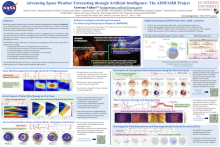
Machine learning (ML) is transforming heliophysics and space weather forecasting by overcoming the fundamental limitations of traditional empirical models. While empirical approaches often rely on simplified assumptions, spatial averaging, or historical climatology, ML techniques excel at capturing the highly complex, non-linear dynamics of the Sun-Earth system directly from vast observational datasets. As the number of these powerful, data-driven models grows, there is a critical need for coordinated development and collaboration. The Artificial Intelligence Modeling Framework for Advancing Heliophysics Research (AIMFAHR) addresses this need as a collaborative effort dedicated to improving individual ML models and transitioning them into real-world space weather applications. In this presentation, we highlight the recent AI modeling efforts of the NASA Goddard AIMFAHR team, featuring multiple models that span the dayside magnetosphere and the Magnetosphere-Ionosphere-Thermosphere (M-I-T) system. Driven by OMNI and L1 monitor data, the AIMFAHR models reveal storm responses across geospace systems from a purely data-driven perspective. Specifically, they capture the spatiotemporal variation of magnetopause reconnection; cusp motion and the evolution of cusp ion energy dispersions; auroral intensification and boundary motion; increases in field-aligned currents (FACs), ionospheric conductance, and potentials; enhanced upper-atmosphere Joule heating; thermospheric density enhancements; and intensified geomagnetic field disturbances. Finally, we will discuss future AIMFAHR activities, which will focus on coupling these individual ML models, quantifying model uncertainties, and transitioning the framework toward operational applications.
Poster PDF
Poster session day
Poster location
36
Meeting homepage