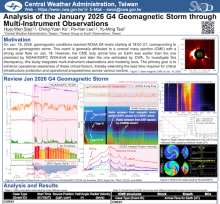
Analysis of the January 2026 G4 Geomagnetic Storm through Multi-Instrument Observations
Huei-Wen
Siao
Central Weather Administration, Taiwan
Poster
On January 19, 2026, geomagnetic conditions reached NOAA G4 levels starting at 18:00 UT, corresponding to a severe geomagnetic storm. This event is generally attributed to a coronal mass ejection (CME) associated with a long-duration X1.9 class solar flare on January 18. While the NOAA/SWPC WSA-Enlil model predicted the onset of near-Earth environmental disturbances at approximately 22:00 UT, observational evidence reveals that the CME impacted the magnetosphere significantly earlier. To investigate this discrepancy, this study integrates multi-instrument observations and modeling tools, including the pyCAT (Python-based CME Analysis Tool, a next-generation CME analysis tool developed by NOAA/SWPC and the UK Met Office), STEREO-A/IMPACT and PLASTIC, and e-CALLISTO radio spectra. We analyze the propagation dynamics and identify potential factors contributing to the unexpectedly high CME velocity. The primary goal is to enhance operational awareness of these critical factors, thereby extending the lead time required for critical infrastructure protection and operational preparedness across various sectors.
Poster PDF
Poster session day
Poster location
26
Meeting homepage