Bridging High-Fidelity Modeling and Operations with Reduced-Order Thermospheric Data Assimilation
Sriram
Narayanan
West Virginia University
Poster
Accurate thermospheric mass density knowledge is critical for precise orbit determination, collision avoidance, and Space Situational Awareness/Space Domain Awareness (SSA/SDA). While physics-based General Circulation Models offer comprehensive atmospheric understanding, their computational demands preclude real-time use. Empirical models, though efficient, struggle to capture nonlinear thermospheric behavior, particularly during storm events. This work presents a data assimilation framework leveraging a reduced-order thermospheric model to bridge this gap toward operational SSA/SDA capability.
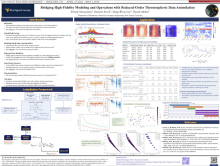
The framework centers on a reduced-order representation of thermospheric density dynamics derived from high-fidelity physics-based simulations, capturing dominant variability modes and their dependence on solar and geomagnetic drivers while enabling rapid propagation and real-time updating. Two reduced-order model classes are considered: a nonlinear sparse identification approach with control inputs (SINDyc) and a linear dynamic mode decomposition baseline (DMDc), both embedded within a Kalman filtering architecture for sequential density observation assimilation.
The framework is evaluated using in situ density measurements from CHAMP, GRACE/GRACE-FO, GOCE, and Swarm missions spanning diverse altitudes, local times, and geomagnetic conditions. Assimilation significantly improves density estimation accuracy over open-loop predictions, particularly during geomagnetically active periods. The nonlinear formulation consistently outperforms the linear baseline under limited observational coverage. A second evaluation phase incorporates the High Accuracy Satellite Drag Model (HASDM) and two-line element (TLE)-based orbital data, demonstrating compatibility with operational pipelines without proprietary inputs.
The framework delivers dynamically consistent density estimates, supports multi-satellite assimilation, and operates at computational costs suitable for real-time use. Future work includes heterogeneous measurement fusion and exploration of particle-based and generative modeling approaches, advancing reduced-order thermospheric data assimilation as an enabling technology for next-generation SSA/SDA systems.
The framework centers on a reduced-order representation of thermospheric density dynamics derived from high-fidelity physics-based simulations, capturing dominant variability modes and their dependence on solar and geomagnetic drivers while enabling rapid propagation and real-time updating. Two reduced-order model classes are considered: a nonlinear sparse identification approach with control inputs (SINDyc) and a linear dynamic mode decomposition baseline (DMDc), both embedded within a Kalman filtering architecture for sequential density observation assimilation.
The framework is evaluated using in situ density measurements from CHAMP, GRACE/GRACE-FO, GOCE, and Swarm missions spanning diverse altitudes, local times, and geomagnetic conditions. Assimilation significantly improves density estimation accuracy over open-loop predictions, particularly during geomagnetically active periods. The nonlinear formulation consistently outperforms the linear baseline under limited observational coverage. A second evaluation phase incorporates the High Accuracy Satellite Drag Model (HASDM) and two-line element (TLE)-based orbital data, demonstrating compatibility with operational pipelines without proprietary inputs.
The framework delivers dynamically consistent density estimates, supports multi-satellite assimilation, and operates at computational costs suitable for real-time use. Future work includes heterogeneous measurement fusion and exploration of particle-based and generative modeling approaches, advancing reduced-order thermospheric data assimilation as an enabling technology for next-generation SSA/SDA systems.
Poster PDF
Poster session day
Poster location
3
Meeting homepage