C-SWIM: A Coupled Space Weather Impact Model for Satellite Fleet Vulnerability and Economic Loss Under a 1-in-100-Year Solar Energetic Particle Event
Dennies
Bor
George Mason University
Poster
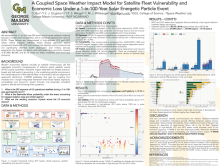
Modern economies depend critically on satellite infrastructure for navigation, communications, weather forecasting, and national security. This growing reliance exposes significant vulnerability to severe space weather, particularly to solar energetic particle (SEP) events, which can degrade or disable spacecraft electronics. However, the aggregate economic consequences of extreme SEP events have not been rigorously assessed. This study develops an integrated framework linking SEP hazard characterization, dynamic geomagnetic cutoff rigidity modeling, radiation dose transport, and fleet-wide failure probability estimation to macroeconomic impact analysis. Using extreme-value analysis of 50 years of proton flux observations, we derive 1-in-100-year event fluences and compute absorbed dose in silicon via spectral transport, combined with trapped-radiation baselines. Failure probability is estimated for ~12,000 US operational satellites using an established radiation-hardness assurance methodology by convolving the total-dose environment distribution with device failure threshold distributions under regime-dependent shielding and component assumptions. The assessment reveals that ~330 satellites (2.6%) are at critical risk of dose-induced failure, concentrated in high-altitude LEO and HEO orbits where trapped-proton-belt doses approach commercial component failure thresholds. Fewer than 700 satellites account for essentially all of the failure risk, while MEO and GEO satellites show effectively zero failure probability under assumed radiation-hardened designs, despite high particle access fractions. The expected capital loss, computed as replacement cost weighted by failure probability across the ~$312B fleet, totals ~$5.9B. Downstream economic impacts are assessed through three failure scenarios that progressively expand the set of failed satellites from critical-only (~330 satellites) to all with non-negligible risk (~5,000 satellites), yielding first-order daily economic impact estimates of $120M, $405M, and $1.66B, respectively, with Earth observation and military services most severely disrupted. This framework provides a first-order link between physical SEP hazards and economic consequences for satellite-dependent sectors.
Poster PDF
Poster session day
Poster location
28
Meeting homepage