Climatology of Orbital Propagation Error in LEO
William
Parker
The Aerospace Corporation
Poster
Unprecedented congestion in LEO has driven surging demand for satellite conjunction assessment, leading to hundreds of thousands of collision avoidance maneuvers annually. Satellite operators must reliably predict trajectories more than 24 hours in advance to identify and mitigate potential conjunctions, but that capability is severely compromised during geomagnetic storms when trajectory predictions are especially poor.
Atmospheric drag is the primary source of propagation error for satellites in LEO. Errors in drag specification come from errors in the forecasts that drive the atmospheric models, errors in the atmospheric models themselves, or errors in the satellite ballistic coefficient. This work seeks to disambiguate the contributions from forecast and model errors in satellite propagation to better understand where new efforts from the space weather research community would provide the highest value for satellite operators.
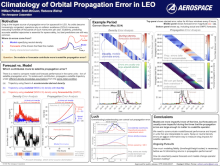
This effort leverages ESA's Swarm satellite data over a solar cycle to assess forecast versus model error impacts on 3-day orbit predictions. A high-fidelity propagator runs three scenarios using (1) forecasted space weather drivers, (2) historical measured drivers, and (3) onboard accelerometer-derived neutral density, isolating errors from forecasts, models, and the propagator (and ballistic coefficient) respectively. Analysis across the solar cycle, particularly during geomagnetic storms, reveals that improving forecasts—not models—is the top priority for reducing orbit prediction errors when operators need accuracy most. This effort should help to better align the space weather research community with the rapidly evolving needs for ensuring space safety in the years ahead.
Atmospheric drag is the primary source of propagation error for satellites in LEO. Errors in drag specification come from errors in the forecasts that drive the atmospheric models, errors in the atmospheric models themselves, or errors in the satellite ballistic coefficient. This work seeks to disambiguate the contributions from forecast and model errors in satellite propagation to better understand where new efforts from the space weather research community would provide the highest value for satellite operators.
This effort leverages ESA's Swarm satellite data over a solar cycle to assess forecast versus model error impacts on 3-day orbit predictions. A high-fidelity propagator runs three scenarios using (1) forecasted space weather drivers, (2) historical measured drivers, and (3) onboard accelerometer-derived neutral density, isolating errors from forecasts, models, and the propagator (and ballistic coefficient) respectively. Analysis across the solar cycle, particularly during geomagnetic storms, reveals that improving forecasts—not models—is the top priority for reducing orbit prediction errors when operators need accuracy most. This effort should help to better align the space weather research community with the rapidly evolving needs for ensuring space safety in the years ahead.
Poster PDF
Poster session day
Poster location
15
Meeting homepage