Design of a Scalable Low-Cost Readout System for the Global gLOWCOST Cosmic Ray Muon Detector Network
Hetti Arachchige Tharindu Gayakantha
Hettiarachchi
Department of Physics and Astronomy, Georgia State University
Poster
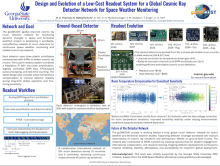
The gLOWCOST (global low cost cosmic ray muon detector network for monitoring of dynamic changes in space and terrestrial weather) project operates an expanding international array of more than twenty muon detectors across ten countries on five continents to provide continuous measurements of cosmic ray variations linked to space and terrestrial weather. Sustaining long-term, reliable observations across such a geographically distributed network requires detector systems that are scientifically capable yet low-cost, robust, and adaptable to diverse environmental conditions.
This work presents the design and iterative development of a custom readout system engineered to support the large-scale deployment of low-cost cosmic-ray detectors. The system integrates a Raspberry Pi with a dedicated readout module incorporating low-noise preamplification, digitally controlled SiPM bias generation, FPGA-based pulse discrimination, and real-time digital counting. Over multiple hardware and firmware generations, the design has evolved to address practical challenges encountered during global field deployments, including electronic noise and temperature-dependent gain variations inherent to SiPM sensors.
A key advancement in the latest generation is an active temperature-compensation mechanism that dynamically adjusts SiPM bias voltage in response to environmental temperature changes. This feature markedly improves count-rate stability and overall detector reliability, particularly in locations lacking controlled laboratory conditions. The resulting readout system provides a scalable and cost-effective solution for expanding ground-based cosmic-ray monitoring and strengthens global efforts to track space-weather-driven variations in cosmic-ray flux.
This work presents the design and iterative development of a custom readout system engineered to support the large-scale deployment of low-cost cosmic-ray detectors. The system integrates a Raspberry Pi with a dedicated readout module incorporating low-noise preamplification, digitally controlled SiPM bias generation, FPGA-based pulse discrimination, and real-time digital counting. Over multiple hardware and firmware generations, the design has evolved to address practical challenges encountered during global field deployments, including electronic noise and temperature-dependent gain variations inherent to SiPM sensors.
A key advancement in the latest generation is an active temperature-compensation mechanism that dynamically adjusts SiPM bias voltage in response to environmental temperature changes. This feature markedly improves count-rate stability and overall detector reliability, particularly in locations lacking controlled laboratory conditions. The resulting readout system provides a scalable and cost-effective solution for expanding ground-based cosmic-ray monitoring and strengthens global efforts to track space-weather-driven variations in cosmic-ray flux.
Poster PDF
Poster session day
Poster location
9
Meeting homepage