Distributed Sensor Array for Mid-Latitude Ionospheric Characterization
Davis
Austin
United States Military Academy
Poster
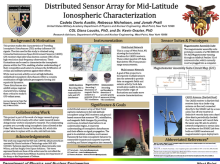
Geomagnetic and ionospheric disturbances can significantly impact both commercial and military communication systems. These disturbances can be detected and characterized using a distributed network of GNSS receivers, magnetometers, radios, seismometers, accelerometers, and electrometers. The mid-latitude regions are studied far less than the polar and equatorial regions. At the United States Military Academy (USMA) in West Point, NY, a distributed network of GNSS receivers and magnetometers is currently being emplaced in a 3 x 3 km area of the West Point Military Reservation to survey mid-latitude ionospheric and geomagnetic disturbances. Data from the CASES GPS receivers provides insight into total electron content (TEC) variation, amplitude scintillation, and phase scintillation. Two of the three planned CASES receivers have been emplaced and are operational. Ground-based magnetometers will provide data on ground-induced currents, field-aligned currents, and local magnetic disturbances. Ground-based magnetometer stations are currently in the late prototype phase and are pending deployment. Data collected from this network will be used to characterize the structures and causal pathways of regional ionospheric and geomagnetic disturbances. This data will be used to inform future analysis of expected geomagnetic and solar events recorded from the distributed array system. This poster also presents the theoretically expected magnetometer and GNSS responses to representative space-weather drivers to support future event attribution and analysis. This project aims to use a novel methodology to document the mid-latitudes with a low-cost instrumentation network and a distributed laboratory for future space weather operations at USMA, providing valuable ionosphere data.
Poster PDF
Poster session day
Poster location
50
Meeting homepage