First Detection of gamma-ray enhancement during the 2025 November 11 GLE by Detectors located at Antarctic and Arctic Stations
Pranali
Thakur
1) Indian Institute of Geomagnetism (IIG), Navi Mumbai, Maharashtra, India; 2) NASAGoddard Space Flight Center, Greenbelt, MD, USA; 3) The Catholic University of America, Washington, DC, USA
Poster
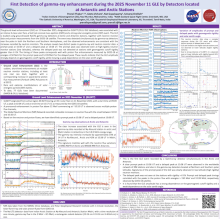
The ground-level enhancement (GLE) on 11 November 2025, designated as GLE#77 (OULU GLE database), was associated with an intense X-class solar flare, a fast halo coronal mass ejection (CME) and a strong solar energetic proton (SEP) event. This GLE is studied using ground-based NaI(Tl) gamma-ray detectors at Arctic and Antarctic stations, together with neutron monitor data and proton measurements from the GOES-18 satellite. The event was detected simultaneously by gamma-ray detectors near the poles in both the Northern and Southern Hemispheres, and the observed enhancements are consistent with the increases recorded by neutron monitors. The analysis reveals two distinct peaks in gamma-ray and neutron monitor data: a prompt peak at 10:38 UT and a delayed peak at 13:08 UT. The prompt peak was observed even at high-rigidity neutron monitor stations (low latitudes), whereas the delayed peak was not detected at stations with geomagnetic cutoff rigidity greater than 6 GV. The timing of these peaks corresponds well with proton flux enhancements measured by GOES-18 at energies >150 MeV for the prompt peak and 12-99 MeV for the delayed peak. These results indicate that the GLE amplitude strongly depends on geomagnetic cutoff rigidity, while showing a weak dependence on the solar zenith angle.
Poster PDF
Poster session day
Poster location
14
Meeting homepage