GONG: A Global Ground-Based Network for Continuous Solar Observations
Alexei
Pevtsov
National Solar Observatory
Poster
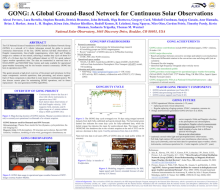
The US National Science Foundation's (NSF) Global Oscillation Network Group (GONG) is a network of 6 robotic telescopes around the globe to provide continuous observations of the Sun. GONG delivers full-disk observations of Doppler measurements, line-of-sight magnetograms, white light and H-alpha images at a cadence of one minute, achieving a median duty cycle of about 0.9 (90% of a 24-hour day) for fully calibrated dataset or 0.95 for quick reduced (space weather operations) data. The data are transmitted in near-real time to NOAA/SWPC and NSO/NISP Data Centers and made available for operational space-weather forecasting and for the broader research community. GONG has been in operation since 1995.
This poster presents a high-level overview of the project and introduces its three major components: network operations, data processing, and science support. Each of these components is described in more detail in coordinated posters. We also discuss current plans for maintaining GONG operations, and its future replacement – the next-generation GONG (ngGONG).
This poster presents a high-level overview of the project and introduces its three major components: network operations, data processing, and science support. Each of these components is described in more detail in coordinated posters. We also discuss current plans for maintaining GONG operations, and its future replacement – the next-generation GONG (ngGONG).
Poster PDF
Poster session day
Poster location
44
Meeting homepage