HASDM-Sol: a Machine-learned Model of Thermospheric Density Trained on Two Solar Cycles
Alexander
Lozinski
Space Environment Technologies
Poster
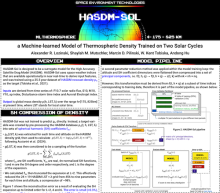
This work introduces a prototype machine-learned thermospheric density model, HASDM-Sol, designed as a surrogate model for the High Accuracy Satellite Drag Model (HASDM). The model uses space weather indices that are available operationally in near real-time to derive input features, and was trained using a 25.5 year database of HASDM nowcast densities as the target variable.
Development of HASDM-Sol emphasizes parameter reduction of the HASDM density target data, which begins on a grid of time, altitude, local solar time and latitude ρH(t, h, LST, λ). This parameter reduction is carried out in two stages: firstly, a spherical harmonic (SH) expansion of log(ρH(LST, λ) x10^12) is calculated to limited order, allowing the local solar time and latitude variation to be expressed along a single dimension of SH coefficients; secondly, the altitude and SH coefficient dimensions are flattened then compressed into a set of principal components inside the model training loop.
We demonstrate how the performance of HASDM-Sol varies over two solar cycles by re-training five versions of HASDM-Sol using the same parameters but different permutations of training data. This creates five year contiguous testing periods for each model, covering 2000-2005, 2005-2010, 2010-2015, 2015-2020 and 2020-2025. Over each testing period, HASDM-Sol statistically outperforms the JB2008 empirical model, producing density estimates that more closely match HASDM.
Development of HASDM-Sol emphasizes parameter reduction of the HASDM density target data, which begins on a grid of time, altitude, local solar time and latitude ρH(t, h, LST, λ). This parameter reduction is carried out in two stages: firstly, a spherical harmonic (SH) expansion of log(ρH(LST, λ) x10^12) is calculated to limited order, allowing the local solar time and latitude variation to be expressed along a single dimension of SH coefficients; secondly, the altitude and SH coefficient dimensions are flattened then compressed into a set of principal components inside the model training loop.
We demonstrate how the performance of HASDM-Sol varies over two solar cycles by re-training five versions of HASDM-Sol using the same parameters but different permutations of training data. This creates five year contiguous testing periods for each model, covering 2000-2005, 2005-2010, 2010-2015, 2015-2020 and 2020-2025. Over each testing period, HASDM-Sol statistically outperforms the JB2008 empirical model, producing density estimates that more closely match HASDM.
Poster PDF
Poster session day
Poster location
21
Meeting homepage