MissionDPT: Simulation and forecasting of radiation doses and health risks for space exploration missions
Shaowen
Hu
KBR, Houston, TX, USA
Poster
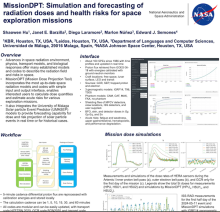
Radiation exposure in space presents significant challenges to crew health and performance. To mitigate its impacts, research in space radiation environment, mass shielding geometry, nuclear interactions, transport codes and biological responses has been conducted for decades, offering many established models and codes. In this work, a web tool MissionDPT (Mission Dose Projection Tool) is presented which incorporates the most up-to-date version of these codes with simple input and output interfaces, enabling interested users to calculate dose quantities and estimate acute risks for low earth orbit (LEO) and beyond LEO missions. Simulation results are consistent with dosimeter measurements from the Artemis-I mission and the International Space Station (ISS) with known shielding files and trajectories. A set of solar particle event (SPE) forecasting models, University of Malaga Solar particle Event Predictor (UMASEP), are also integrated to provide dose information before or near the onset of SPEs. With archived Geostationary Operational Environmental Satellite (GOES) solar proton data from 1986 to present (real time data updated every 5 minutes), MissionDPT can be used to analyze the radiation exposure and acute health risks for historical severe SPEs and to serve as a console tool for the Flight Control Team in contingency scenarios for the upcoming lunar and Mars missions.
Poster PDF
Poster session day
Poster location
3
Meeting homepage