Multi-Instrument Analysis of Low Latitude Ionospheric Perturbations During Intense Geomagnetic Storm in the descending phase of solar cycle 24
Kshama
Tiwari
College of Engineering, Design and Computing, University of Colorado, Denver, CO 80204, USA
Poster
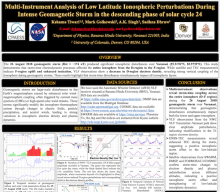
Geomagnetic storms, driven by fast-moving solar plasma from coronal holes or Coronal Mass Ejections (CMEs) interacting with the interplanetary magnetic field (IMF), induce significant disturbances in the Earth's magnetosphere-ionosphere system. This study presents a comprehensive analysis of the low latitude ionospheric response during the intense geomagnetic storm of 26 August 2018, occurring during the descending phase of solar cycle 24. The combined analysis of VLF propagation, GNSS-TEC measurements, and satellite observations provides a comprehensive understanding of the low latitude ionospheric response to geomagnetic storms over multiple altitude regions.
Using sub-ionospheric Very Low Frequency (VLF) signals from the NWC transmitter monitored at Varanasi, India, we identify a pronounced decrease in VLF amplitude during the storm's nighttime main phase. To quantify these D-region modifications, the anomalies were modeled using the Long-Wave Propagation Capability (LWPC) code. Results indicate a significant shift in Wait’s ionospheric parameters: the reference height (H') increased by approximately 7.4–7.6 km, while the sharpness factor (beta) decreased from 0.07 to 0.03 km⁻¹ during the main and recovery phases.
To further understand the ionospheric response, Global Navigation Satellite System (GNSS)-derived Total Electron Content (TEC) measurements were analyzed. TEC, which represents the integrated electron density along the signal path, exhibited significant fluctuations during the storm period. Furthermore, satellite data from the Defense Meteorological Satellite Program (DMSP) and SWARM missions reveal the presence of plasma depletions in the Asian sector. Interestingly, these depletions occurred in the absence of Equatorial Plasma Bubbles (EPBs), suggesting they were generated by local sources at low and mid-latitudes during geomagnetic disturbances. This multi-technique approach provides a detailed view of the coupling between solar forcing and the multi-layered ionosphere at low latitudes.
Using sub-ionospheric Very Low Frequency (VLF) signals from the NWC transmitter monitored at Varanasi, India, we identify a pronounced decrease in VLF amplitude during the storm's nighttime main phase. To quantify these D-region modifications, the anomalies were modeled using the Long-Wave Propagation Capability (LWPC) code. Results indicate a significant shift in Wait’s ionospheric parameters: the reference height (H') increased by approximately 7.4–7.6 km, while the sharpness factor (beta) decreased from 0.07 to 0.03 km⁻¹ during the main and recovery phases.
To further understand the ionospheric response, Global Navigation Satellite System (GNSS)-derived Total Electron Content (TEC) measurements were analyzed. TEC, which represents the integrated electron density along the signal path, exhibited significant fluctuations during the storm period. Furthermore, satellite data from the Defense Meteorological Satellite Program (DMSP) and SWARM missions reveal the presence of plasma depletions in the Asian sector. Interestingly, these depletions occurred in the absence of Equatorial Plasma Bubbles (EPBs), suggesting they were generated by local sources at low and mid-latitudes during geomagnetic disturbances. This multi-technique approach provides a detailed view of the coupling between solar forcing and the multi-layered ionosphere at low latitudes.
Poster PDF
Poster session day
Poster location
9
Meeting homepage