Physics-Informed ML Framework for Thermosphere Density Prediction
Immanuel
Ulinfun
West Virginia University
Poster
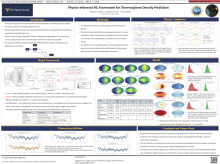
Accurate thermospheric density prediction is critical for satellite drag estimation and space weather operations, yet existing approaches face a fundamental tension: data-driven models achieve good statistical performance but do not explicitly satisfy governing physical laws, while high-fidelity physics simulations remain computationally expensive for real-time use. This work presents a Physics-Informed Neural Network (PINN) framework that bridges this gap by constraining conventional ML architectures with the Walker diffusive equilibrium equations and the Bates temperature profile. Rather than predicting density directly, the network learns the exospheric temperature T_\infty and full altitude-dependent temperature profiles T(z) that render CHAMP satellite density observations physically self-consistent, enforcing barometric law and species-specific scale heights by construction. Trained on approximately 24 million CHAMP observations spanning 2002–2009, preliminary results show the physics-informed framework achieves a MAPE of 15.26% and R² of 0.8717, compared to 16.29% and 0.8692 for a purely data-driven baseline. This framework is hence designed to extend naturally to incorporate broader governing laws, including continuity and momentum equations from established physics-based models, with pathways to adapt these constraints across coordinate systems to capture Earth's geometric and geophysical structure better, therefore providing better confidence when extrapolating to unseen conditions. Operational trust in ML-based space weather tools remains a critical barrier to deployment. By constraining models to satisfy established governing laws and leveraging the network's nonlinear capacity to accommodate complexity beyond their scope, this framework advances toward solutions that are not only accurate but defensible, combining the interpretability of first-principles models with the efficiency of modern machine learning.
Poster PDF
Poster session day
Poster location
6
Meeting homepage