Recreating the enhanced neutron environment of GLE 77 at TRIUMF
Alex
Hands
TRIUMF
Poster
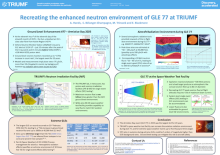
On Armistice Day (11th November) 2025, the largest ground level enhancement (GLE) for 20 years was observed by ground level neutron monitors and high-altitude detectors. Increases in ground level neutron flux during GLE 77 peaked at around 175% at Antarctic stations. At higher altitudes increases in neutron flux are even greater, with both models and measurements indicating an order of magnitude increase at commercial flight levels, and even more for high-altitude aircraft. Commensurate increases in single event effects (SEE) rates in avionics would be expected as a result.
The neutron irradiation facility (NIF) at TRIUMF recreates an atmospheric-like neutron spectrum over a wide intensity range. This provides a unique capability to test aircraft electronics in a simulated GLE environment, rather than scaling measured error rates from either an accelerated test facility or long-duration experiments on the ground. NIF’s flux range encompasses the 2025 Armistice Day event and events several orders of magnitude larger that have been observed indirectly via cosmogenic isotope records. GLE 77, though large by recent standards, is estimated to be only ~2% of the intensity of GLE 5, which occurred 70 years ago on 23rd February 1956 and remains the largest event ever directly measured. The relatively benign period of solar activity that has been experienced over the last few decades will eventually come to end. Given the inherent lack of warning associated with GLEs, resilience through ground testing is essential to mitigating their impact on aviation.
The neutron irradiation facility (NIF) at TRIUMF recreates an atmospheric-like neutron spectrum over a wide intensity range. This provides a unique capability to test aircraft electronics in a simulated GLE environment, rather than scaling measured error rates from either an accelerated test facility or long-duration experiments on the ground. NIF’s flux range encompasses the 2025 Armistice Day event and events several orders of magnitude larger that have been observed indirectly via cosmogenic isotope records. GLE 77, though large by recent standards, is estimated to be only ~2% of the intensity of GLE 5, which occurred 70 years ago on 23rd February 1956 and remains the largest event ever directly measured. The relatively benign period of solar activity that has been experienced over the last few decades will eventually come to end. Given the inherent lack of warning associated with GLEs, resilience through ground testing is essential to mitigating their impact on aviation.
Poster PDF
Poster session day
Poster location
20
Meeting homepage