Relationship between Pulsations and GICs during the April 2023 Geomagnetic Storm
Hanyu
Lin
United States Military Academy
Poster
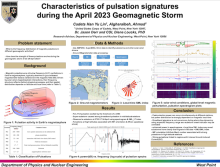
Our research focuses on the characteristics of geomagnetic pulsations and their association with geomagnetically induced currents (GICs) during the April 2023 geomagnetic storm using ground-based magnetometers. Geomagnetic storms, substorms, and ultra-low frequency (ULF) waves can drive GICs. Distinct ULF waves have been associated with the foreshock, substorm onset, solar wind pressure pulses, Kelvin-Helmholtz instability and more. The extent to which different magnetic pulsations and broadband ULF signatures influence GIC generation differently remains insufficiently understood. We aim to contribute to the understanding of causes for different magnetic pulsations and their unique relationships to GICs during geomagnetic activity.
Using OMNI, SuperMAG indices, and ground magnetometer data from the CARISMA and the UAF arrays, we examine the cause-effect relationships of geomagnetic pulsations during the April 2023 storm. Power spectra are generated for each station at any time when a power threshold is exceeded. We compare the resulting pulsation spikes to GIC responses, solar wind conditions, and geomagnetic activity indicators. Key findings include:
1. Some pulsations are associated with a strong GIC response but no obvious geomagnetic activity or solar wind changes, potentially indicating localized ULF wave-driven GICs.
2. Solar wind conditions and substorm activity excite pulsations in a broad frequency range; this suggests that using a specific type of pulsation as an indicator of substorm onset during storm time might not be accurate.
3. Peak pulsation power can occur simultaneously at different stations, but power distribution is strongly dependent on magnetic local time.
Using OMNI, SuperMAG indices, and ground magnetometer data from the CARISMA and the UAF arrays, we examine the cause-effect relationships of geomagnetic pulsations during the April 2023 storm. Power spectra are generated for each station at any time when a power threshold is exceeded. We compare the resulting pulsation spikes to GIC responses, solar wind conditions, and geomagnetic activity indicators. Key findings include:
1. Some pulsations are associated with a strong GIC response but no obvious geomagnetic activity or solar wind changes, potentially indicating localized ULF wave-driven GICs.
2. Solar wind conditions and substorm activity excite pulsations in a broad frequency range; this suggests that using a specific type of pulsation as an indicator of substorm onset during storm time might not be accurate.
3. Peak pulsation power can occur simultaneously at different stations, but power distribution is strongly dependent on magnetic local time.
Poster PDF
Poster session day
Poster location
51
Meeting homepage