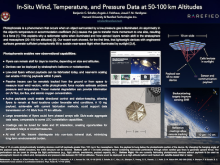
In-Situ Wind, Temperature, and Pressure Data at 50-100 km Altitudes
Benjamin
Schafer
Rarefied Technologies Inc.
Poster
Recent work has demonstrated sunlight-powered photophoretic flight of centimeter-scale perforated structures under near-space conditions, establishing a new class of aircraft capable of sustained operation in the mesosphere. These platforms exploit thermally-induced rarefied gas flows to fly at pressures between 30 and 100 km altitudes, a region that remains poorly observed despite its critical role in space weather coupling between the neutral atmosphere and ionosphere. Building on experimental and modeling results reported in Nature, we describe how photophoretically levitating platforms can be adapted as scientific tools for space weather research. Passive devices can function as atmospheric tracers, enabling direct measurements of wind speed and direction through optical or radar tracking over spatial and temporal scales inaccessible to sounding rockets. Larger devices could loft payloads on the order of 100 mg, allowing in-situ measurements of variables including pressure, temperature, and ion concentration in the mesosphere and lower thermosphere. Because lift is generated without fuel, batteries, or photovoltaics, these platforms decouple observational persistence from onboard power and enable low-cost distributed sampling of a traditionally inaccessible altitude. We discuss demonstrated flight conditions, projected payload capacities as a function of altitude, deployment concepts using balloons or sounding rockets, and outline how photophoretic near-space platforms could complement satellite, radar, and ground-based measurements in future space weather observation.
Poster PDF
Poster session day
Poster location
3
Meeting homepage