Solar Shenanigans: Space Weather Event Preparedness and Practice in Aotearoa New Zealand
Jonathan
Hanson
Earth Sciences New Zealand
Poster
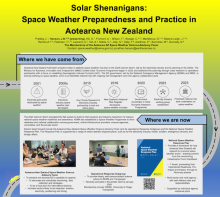
The Gannon storm of May 2024 significantly raised New Zealand’s awareness of space weather risks, prompting focused consideration of our readiness and raising an important question: are we truly ready?
Led by the National Emergency Management Agency (NEMA), the New Zealand Government, space weather scientific community, and electricity industry united to rapidly improve our readiness in the following key directions:
1. Developed the National Space Weather Response Plan, which promotes effective emergency management and a coordinated response across NZ
2. Established a Space Weather Science Advisory Panel plus a response-focused sub-group. The wider panel contains representatives from NZ Science Agencies (Earth Sciences New Zealand), universities (notably the University of Otago) and impacted sector representatives. The sub-group is smaller, agile, contains deeper expertise, and is focused on delivering rapid scientific advice to NEMA and the electricity sector.
3. Conducted the two-day national Exercise Tahu-nui-ā-rangi, which enacted a maximum credible space weather event to test the readiness of both the national plan and NZ, including NEMA, the Science Advisory Panel, and supporting agencies and sectors nationwide.
These steps form part of wider efforts to connect with domestic and international partners, raising the profile of space weather and building on the strong foundations of domestic science and research, notably the ongoing Solar Tsunamis research-to-operations programme.
Overall, New Zealand has made substantial progress — from novice to well‑informed and increasingly resilient actor — by taking a domestically and internationally connected approach, focused on understanding and managing potential consequences.
Led by the National Emergency Management Agency (NEMA), the New Zealand Government, space weather scientific community, and electricity industry united to rapidly improve our readiness in the following key directions:
1. Developed the National Space Weather Response Plan, which promotes effective emergency management and a coordinated response across NZ
2. Established a Space Weather Science Advisory Panel plus a response-focused sub-group. The wider panel contains representatives from NZ Science Agencies (Earth Sciences New Zealand), universities (notably the University of Otago) and impacted sector representatives. The sub-group is smaller, agile, contains deeper expertise, and is focused on delivering rapid scientific advice to NEMA and the electricity sector.
3. Conducted the two-day national Exercise Tahu-nui-ā-rangi, which enacted a maximum credible space weather event to test the readiness of both the national plan and NZ, including NEMA, the Science Advisory Panel, and supporting agencies and sectors nationwide.
These steps form part of wider efforts to connect with domestic and international partners, raising the profile of space weather and building on the strong foundations of domestic science and research, notably the ongoing Solar Tsunamis research-to-operations programme.
Overall, New Zealand has made substantial progress — from novice to well‑informed and increasingly resilient actor — by taking a domestically and internationally connected approach, focused on understanding and managing potential consequences.
Poster PDF
Poster session day
Poster location
34
Meeting homepage