Space Atlas - Driver-resolved attribution and forecasting of voxel-level thermospheric density, with per-edge uncertainty and learned time-lag
Heidi
Bennett
Nervous Machine
Poster
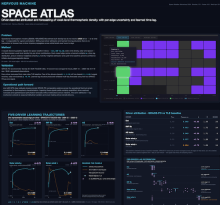
Operational thermospheric models provide bulk density estimates but lack driver-resolved attribution and forward prediction of how perturbations propagate spatially and temporally. We present a causal discovery framework that decomposes density variations at the voxel level into individual drivers: solar EUV, geomagnetic activity, seasonal-latitudinal patterns, solar wind dynamic pressure, and Joule heating, while learning the time-lag structure governing how each driver's influence persists across orbital shells. The learned lag structure enables forward prediction: given a driver impulse, the model forecasts how the resulting density perturbation evolves across voxels over hours to days, with certainty quantified per edge.
We validated across two data regimes to isolate the role of observation cadence. On NOAA/NCEI TLE debris catalog data (156 voxels, 726 validated causal edges), the pipeline achieved 16% MAPE for bulk density versus 85% for JB2008 under equivalent storm conditions. However, TLE cadence (~daily) proved insufficient to resolve temporal lag structure. Certainty dropped under tighter driver attribution requirements, confirming that daily observations cannot support per-driver causal decomposition or forward prediction.
Retraining the identical pipeline on GRACE-FO accelerometer-derived density (sub-minute cadence) recovered both attribution and prediction: all five drivers exceeded 0.91 certainty, 93% of edges surpassed Z=0.80, and the learned lag model produced validated multi-day forecasts using GRACE-FO as error signal. Condensed temporal sampling enabled the pipeline to learn how perturbations propagate, not merely where they are.
Live LEO GPS drag residuals already provide GRACE-FO-comparable cadence but remain unexploited for thermospheric characterization. Our framework can ingest these signals to deliver certainty-quantified, driver-resolved nowcasts and spatiotemporal perturbation forecasts without dedicated science missions. We present the causal graph structure, certainty evolution across regimes, and a prototype voxel-level forecasting pipeline.
We validated across two data regimes to isolate the role of observation cadence. On NOAA/NCEI TLE debris catalog data (156 voxels, 726 validated causal edges), the pipeline achieved 16% MAPE for bulk density versus 85% for JB2008 under equivalent storm conditions. However, TLE cadence (~daily) proved insufficient to resolve temporal lag structure. Certainty dropped under tighter driver attribution requirements, confirming that daily observations cannot support per-driver causal decomposition or forward prediction.
Retraining the identical pipeline on GRACE-FO accelerometer-derived density (sub-minute cadence) recovered both attribution and prediction: all five drivers exceeded 0.91 certainty, 93% of edges surpassed Z=0.80, and the learned lag model produced validated multi-day forecasts using GRACE-FO as error signal. Condensed temporal sampling enabled the pipeline to learn how perturbations propagate, not merely where they are.
Live LEO GPS drag residuals already provide GRACE-FO-comparable cadence but remain unexploited for thermospheric characterization. Our framework can ingest these signals to deliver certainty-quantified, driver-resolved nowcasts and spatiotemporal perturbation forecasts without dedicated science missions. We present the causal graph structure, certainty evolution across regimes, and a prototype voxel-level forecasting pipeline.
Poster PDF
Poster session day
Poster location
18
Meeting homepage