Spacecraft Environment Discharges in the Geostationary Environment: Radio Signatures and Relationship to Plasma Population and Geomagnetic Indices
Todd
Anderson
Los Alamos National Laboratory
Poster
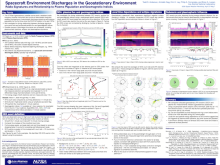
Charging by the plasma environment is a leading cause of detrimental impacts to spacecraft in geostationary orbit, including memory upsets, operational anomalies, and even loss of mission. Studies of spacecraft charging generally either compare >100 keV particle flux with anomaly occurrence rates as a proxy for internal charging or measure the spacecraft surface potential using plasma analyzers. Radio frequency (RF) signatures of onboard discharges may be a direct measure of the space environment’s charging effects on a spacecraft. These have not been measured in geostationary orbit since the Spacecraft Charging At High Altitudes (SCATHA) mission in 1979-1980. Determining the important plasma energy regimes associated with such discharges has therefore proved challenging, especially at energies <50 keV.
The Space Test Program-Satellite 6 (STPSat-6) presents a unique opportunity to examine the dependence of surface charging on the lower-energy portion of the geostationary plasma population. STPSat-6 carries two relevant instruments: the Radio Frequency Sensor (RFS), a VHF radio receiver; and the Z-Plasma Spectrometer (ZPS), a suite of electrostatic analyzers. In addition to lightning-generated emissions, RFS detects non-dispersed transients that we term spacecraft environment discharges (SEDs). The low energy instrument of ZPS measures both electron and ion flux in 72 channels between 2 eV/q and 50 keV/q.
We present an analysis of the occurrence rates of SEDs measured on STPSat-6 and compare these with electron and ion flux measured aboard the spacecraft, as well as geomagnetic indices. We additionally present case studies of SED occurrence during spacecraft eclipse and substorm injections.
The Space Test Program-Satellite 6 (STPSat-6) presents a unique opportunity to examine the dependence of surface charging on the lower-energy portion of the geostationary plasma population. STPSat-6 carries two relevant instruments: the Radio Frequency Sensor (RFS), a VHF radio receiver; and the Z-Plasma Spectrometer (ZPS), a suite of electrostatic analyzers. In addition to lightning-generated emissions, RFS detects non-dispersed transients that we term spacecraft environment discharges (SEDs). The low energy instrument of ZPS measures both electron and ion flux in 72 channels between 2 eV/q and 50 keV/q.
We present an analysis of the occurrence rates of SEDs measured on STPSat-6 and compare these with electron and ion flux measured aboard the spacecraft, as well as geomagnetic indices. We additionally present case studies of SED occurrence during spacecraft eclipse and substorm injections.
Poster PDF
Poster session day
Poster location
19
Meeting homepage