Thermospheric Neutral Species Reduced Order Probabilistic Emulator: Dimensionality Reduction
Nathaniel
Michek
West Virginia University
Poster
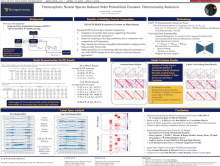
With the increase in satellite density in low Earth orbit, drag modeling remains a key challenge for operators. While drag is affected by multiple factors, the most uncertain variable is the density of the upper atmosphere, given the system's solar-driven nature. This work focuses on improving thermospheric modeling capabilities by developing Reduced Order Probabilistic Emulators (ROPE) for the neutral species of the thermosphere. There are multiple benefits of developing models for neutral composition. First, modeling the neutral species and temperature allows for augmentation of sparse density data. Secondly, expanding to the higher parameter space is a step towards incorporating ionosphere-thermosphere coupling. Thirdly, the use of species opens the option to incorporate further physical processes into the network training or utilize the ROPE to drive physics-informed machine learning models. Finally, developing this type of ROPE allows for improved modeling of the drag coefficient, a key uncertainty in atmospheric drag. The dimensionality reduction component of this work is based on convolutional orthogonal autoencoders (COAE) and compresses TIE-GCM data for the neutral species and temperature on a 36 x 72 x 45 grid. This results in a spatial dimensionality of 116,640 and a total dimensionality of 583,200. To remain relevant for operational use cases, the full dimensionality is reduced with a 583,200:10 compression ratio. The models provide significant improvements in reconstruction abilities over classical PCA-based models at the same compression ratios, while outperforming PCA models with a three times reduction in compression ratio.
Poster PDF
Poster session day
Poster location
7
Meeting homepage