Validating AENEAS: Assessing the UK Operational Model for Space Weather Forecasting
Jack
Brown
University of Birmingham
Poster
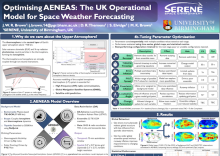
Accurate representation of the coupled ionosphere-thermosphere (I-T) system is critical for reliable space weather operations, as disturbances in this region can disrupt High Frequency (HF) radio communication, Global Navigation Satellite Systems (GNSS), and satellite orbit predictions. To address this need, operational data assimilation models such as the Advanced Ensemble Networked Assimilation System (AENEAS), deployed at the UK Met Office, combine physics-based models with observations to nowcast and forecast the upper atmosphere. AENEAS uses the Thermosphere-Ionosphere-Electrodynamics General Circulation Model (TIE-GCM) as its background model and assimilates a range of measurements from GNSS, in-situ satellites, and ionosonde observations. This study presents a systematic optimisation and validation of the latest version of AENEAS, focusing on configurable model parameters governing ensemble generation and the weighting of assimilated observations. Different model configurations are evaluated under both geomagnetically quiet and disturbed conditions using statistical performance metrics to identify an optimal configuration. Global ionosonde observations of the ionospheric F2 region, specifically the critical frequency (foF2) and the height of peak electron density (hmF2), are used as an independent validation dataset, with comparisons to established upper atmosphere models providing a benchmark for AENEAS performance. Results show that targeted parameter tuning improves key ionospheric performance metrics and reduces known model limitations and biases. These findings improve understanding of AENEAS sensitivity to ensemble and assimilation settings, support the development of an improved operational configuration, and establish a foundation for comprehensive future validation campaigns.
Poster PDF
Poster session day
Poster location
8
Meeting homepage