PISCES: Physics-Informed Convolutional Autoencoder for Solar-Wind Anomaly Detection and Space-Weather Early Warning
Alison
March
University of Colorado, Boulder
Oral and Poster
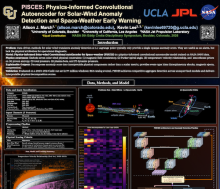
Space weather early warning depends on detecting solar wind transients at the Sun-Earth L1 Lagrange point, where upstream measurements provide tens of minutes of lead time before arrival at Earth’s magnetosphere. Data-driven methods can detect complex multivariate transient signatures that threshold-based methods miss, yet they typically collapse the result into a scalar anomaly score with little indication of physical attribution. We present Physics-Informed Solar-wind Convolutional autoEncoder for Space-weather (PISCES), a physics-informed convolutional autoencoder that integrates physics constraints into the training loss: magnetic field consistency, Parker spiral angle, temperature-velocity relationship, and smoothness of proton entropy, total pressure, plasma beta, and dynamic pressure. PISCES is trained on NASA OMNI data. At inference, the output is decomposed into physics components spanning magnetic, plasma, physics-violation terms, and residual corrections. These components provide event-type hints such as interplanetary shock, magnetic ejecta, and compression region. On the held-out set matched to cataloged events, PISCES achieves competitive PR-AUC results among unsupervised baselines while showing which physical signatures drive each detection rather than only reporting a scalar anomaly score.
Poster PDF
Presentation file
Meeting homepage
Abstract category
Risk and Resiliency to Space Weather Disruption