CPAESS | NASA Jack Eddy Fellow Links Arctic Surface Changes to the Upper Atmosphere
NASA Jack Eddy Postdoctoral Fellow Sunil Kumar recently published the results of research that links long-term changes in the Arctic surface to the dynamics of the stratosphere, mesosphere, and lower thermosphere. His work is published in the Journal of Geophysical Research: Atmospheres.

Sunil Kumar is a 2024 NASA Jack Eddy Postdoctoral Fellow, a program made possible through NASA and UCAR | CPAESS.
Credit: Sunil Kuma
Kumar’s research focuses on the stratospheric polar vortex (SPV), a circulation pattern that forms during the Northern Hemisphere winter over the Arctic. It has been established that planetary waves originating in the troposphere can alter the SPV, either strengthening or weakening it. These changes in the SPV can affect weather patterns closer to Earth and influence the chemistry and dynamics of the mesosphere, thermosphere, and ionosphere.
Using NASA’s Modern Era Retrospective Research analysis for Research and Application-2 (MERRA-2) reanalysis dataset, Kumar examined how climatological variations in Arctic surface conditions – particularly sea surface temperatures – affect SPV strength. His study shows that warming in different regions influences the strength of the vortex in distinct ways by modulating planetary wave activity.
Kumar’s research highlights two time periods. From 1980 to the early 2000s, the SPV weakened when it interacted with stronger planetary waves driven by warming in the Barents-Kara Sea. However, after the early 2000s, the SPV strengthened as it encountered weaker planetary waves associated with warming in the North Central Pacific. Using the Whole Atmosphere Community Climate Model (WACCM-X), Kumar further demonstrated that these long-term changes in the SPV also lead to measurable impacts in the upper atmosphere.
“The societal consequences of long-term changes in the upper atmosphere stem from our technological dependence on this region, where satellites orbit and radio signals traverse. In essence, the variations in the upper atmosphere directly impact GPS, communication networks, space debris, and the functioning of satellites,” said Kumar.
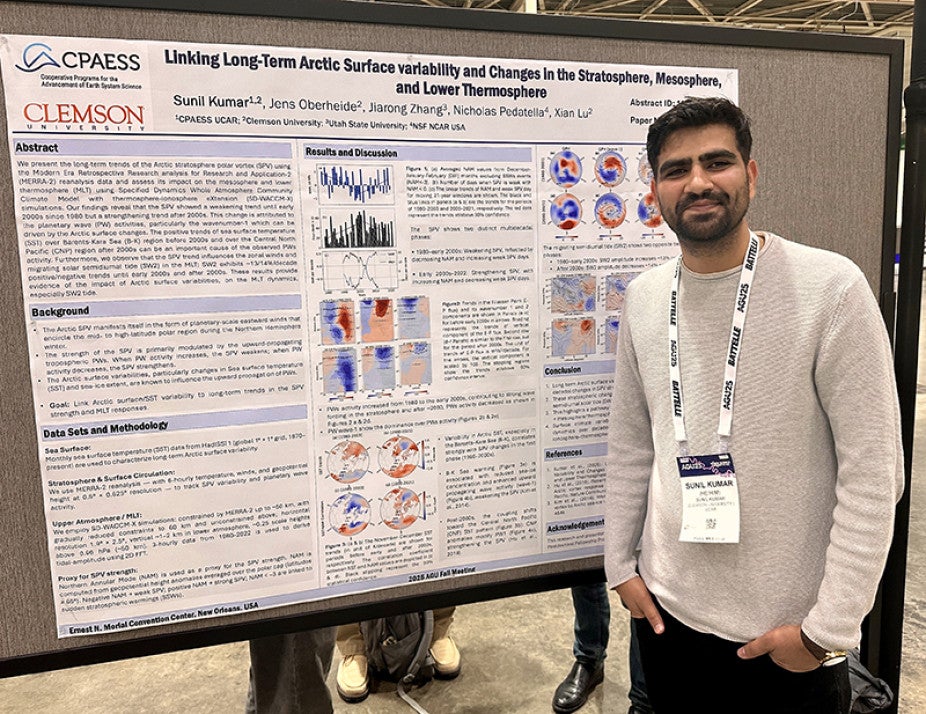
Sunil at AMS last year presenting this new research.
Credit: CPAESS
Further, he notes that this is the “first study to assess the impact of climatological changes in Arctic sea surface temperatures on the upper atmosphere independently of the long-term effects driven by increasing greenhouse gas emissions.”
Experiential learning opportunities are central to training the next generation of heliophysics scientists. To foster these opportunities, UCAR | Cooperative Programs for the Advancement of Earth System Science (CPAESS) joined the NASA Living With a Star Program to create the Jack Eddy Postdoctoral Fellowship, matching early career scientists with experienced scientists at U.S. research institutions.