New Arctic Resource Kit Translates Arctic Report Card for Science Teachers
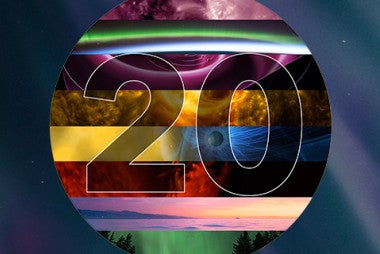
The National Oceanic and Atmospheric Administration (NOAA), along with national and international partners, released its Arctic Report Card (ARC) 2025, marking its 20th anniversary. Every year since 2006, NOAA has published the ARC, a timely, peer-reviewed report on the current state of the Arctic system as compared to historical records.
The ARC is published for those interested in monitoring the science of the Arctic environment, from scientists to decision-makers as well as K-12 teachers.

Heather Heenehan, UCAR | CPAESS Education and Outreach Specialist with the NOAA Ocean Acidification Program (OAP) and the Global Ocean Monitoring and Observing Program (GOMO), works with the NOAA Adopt a Drifter Program.
Credit: Heather Heenehan
Further translating the science of the ARC for use by classroom teachers falls into the wheel house of Heather Heenehan, UCAR | CPAESS Education and Outreach Specialist with the NOAA Global Ocean Monitoring and Observing (GOMO) program. She is focused on making sure that teachers at all levels are confident in their understanding of the ARC and have the tools they need to introduce it to their students.
The first step involved engaging directly with educators. Alongside ARC editors and lead authors, Heenehan and her colleagues shared the latest Arctic science and ways to incorporate it into their curricula at the National Science Teaching Association’s (NSTA) Science Update webinar in January 2026.
During the presentation, Heenehan introduced teachers to the Arctic Report Card Resource Kit, a curated set of resources designed to help educators bring the ARC into their classrooms.
“Teachers come to the NSTA – virtually and in person – to learn and they want to be able to bring the latest science back to their classrooms, so that was the impetus for the webinar but for the Resource Kit, too,” said Heenehan. “ She wanted to be sure that teachers could find materials related to some of the main headlines of the ARC, from record setting temperatures to changes in sea ice extent or how they could bring the new data dashboard to their students in meaningful, practical ways.
The Resource Kit, designed for the website by UCAR | CPAESS Web Developer Melissa Hiatt, is organized into four sections: Background information for educators, Engage your students, Dive in deeper, and For younger learners.
One exercise might involve students observing and comparing photos visualizing changes in the Arctic over time using some of the graphics presented during the NSTA webinar about rusting rivers, tundra greenness, sea ice extent, and glacier retreat.
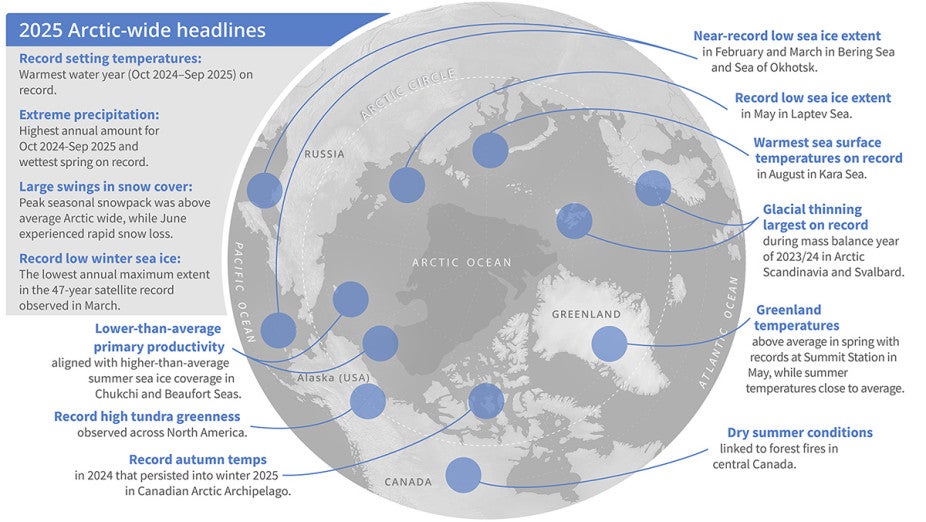
A sample of notable events and important topics from across the Arctic.
Credit: NOAA
Heenehan has tapped into the ARC’s wealth of information in her own college-level teaching. “My environmental studies students read an essay written by indigenous authors from a recent ARC,” she said. “I used it to introduce them to, and start conversations around, indigenous worldviews, indigenous and traditional knowledge, and the environment. This was a new experience for many of them.”
Heenehan notes that the ARC is impressive in that it is published annually and involves more than one hundred authors from around the world. The Resource Kit will continue to grow and offer more tools for educators as the ARC evolves.
“It is our way of helping to bring this amazing and timely product to educators and their students,” said Heenehan.
This resource kit was inspired and informed by the NOAA Office of Education and their Back to school bundles: NOAA resource kits for your classroom.