Calibration and Validation of the SOLAR-1 Magnetometer
Konstantinos
Horaites
CIRES, NOAA
Poster
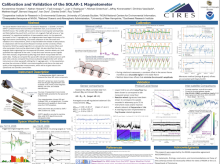
The Space Weather Observations at L1 to Advance Readiness - 1 (SOLAR-1, formerly SWFO-L1) NOAA mission was launched in September 2025, as a successor to the DSCOVR mission. The satellite will be used to observe incoming solar wind particles and fields before they reach Earth, and the in situ magnetic field will serve as a "key parameter" for operational prediction of space weather events. As the spacecraft journeyed to the L1 Lagrange point, our magnetometer team began the process of in-flight instrument commissioning. This entails calibration of the instrument and validation of its measurements, which is required before the release of data products. In collaboration with the Southwest Research Institute and the University of New Hampshire, NOAA has applied algorithms to calculate the instrumental offsets and other parameters that must be determined in-flight. We also identified the stray magnetic fields originating from the spacecraft (thrusters, reaction wheels, etc.) and quantified the magnitude of the noise. To help end-users remove spurious signals from their analyses, we generated quality flags that will be incorporated with the public data. Finally, we compared the spacecraft's inboard and outboard sensors with each other, and also compared the primary (outboard) magnetometer with similar instruments on other spacecraft orbiting the L1 Lagrange point. In this presentation, we show the outcomes of NOAA's commissioning efforts and discuss the state and quality of the magnetometer measurements, which will be of great value to the operational and scientific communities.
Poster PDF
Poster session day
Poster location
28
Meeting homepage