The H3lioViz R2O2R Project: a web application using co-production to enhance both research and operations
Jenny
Knuth
SWx TREC, LASP/University of Colorado, Boulder
Poster
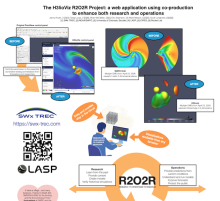
A recent report highlighted the challenges of establishing a reciprocal flow of concepts and tools between research and operations (R2O2R). Here we present a successful R2O2R project in heliosphere modeling and space weather forecasting.
H3lioViz (pronounced “he-lio-viz”) is a web application that visualizes the 3D outputs of the Enlil heliosphere model through a streamlined browser interface. By leveraging cloud computing, users can interact with the large data cubes that remain in the cloud while comparatively small rendered images are sent to the browser. This enables relatively fast visualization on any computer and multiple users can explore the same data simultaneously, without the need for specialized software or high-performance hardware.
H3lioViz harnesses the sophisticated 3D rendering capabilities of ParaView with a pared-down interface featuring the elements researchers and operational forecasters deemed most essential. Users can easily save and share views and settings via a URL link, supporting collaboration, training, forecasting, and research.
The application code has been deployed to the SWPC testbed for internal use by forecasters, while a public site (https://swx-trec.com/h3lioviz) allows anyone to explore the latest model runs. Researchers can investigate historical simulations, while operational forecasters can analyze and contextualize current predictions, ultimately improving space weather forecasting.
Key factors in the project’s success include close co-production with users, an iterative development cycle with live demonstration deployments, and containerized code deployed in the SWPC testbed.
H3lioViz (pronounced “he-lio-viz”) is a web application that visualizes the 3D outputs of the Enlil heliosphere model through a streamlined browser interface. By leveraging cloud computing, users can interact with the large data cubes that remain in the cloud while comparatively small rendered images are sent to the browser. This enables relatively fast visualization on any computer and multiple users can explore the same data simultaneously, without the need for specialized software or high-performance hardware.
H3lioViz harnesses the sophisticated 3D rendering capabilities of ParaView with a pared-down interface featuring the elements researchers and operational forecasters deemed most essential. Users can easily save and share views and settings via a URL link, supporting collaboration, training, forecasting, and research.
The application code has been deployed to the SWPC testbed for internal use by forecasters, while a public site (https://swx-trec.com/h3lioviz) allows anyone to explore the latest model runs. Researchers can investigate historical simulations, while operational forecasters can analyze and contextualize current predictions, ultimately improving space weather forecasting.
Key factors in the project’s success include close co-production with users, an iterative development cycle with live demonstration deployments, and containerized code deployed in the SWPC testbed.
Poster PDF
Poster session day
Poster location
35
Meeting homepage