Limb‐Flare (and beyond-Limb Flare) Prediction with a 4π Full‐Heliosphere Framework
KD
Leka
NWRA
Poster
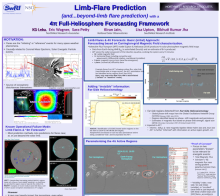
A demonstrated failure mode for operational solar flare forecasting is the inability to forecast flares that occur near, or just beyond, the solar limb. To address this shortcoming, we have developed a “4π” full‐ heliosphere event forecasting framework and evaluated its classification ability against this specific challenge. A magnetic surface flux transport model is used to generate full‐sun maps of the photospheric radial magnetic field from which active regions (ARs) are identified and tracked using a new labeling scheme that (contrary to the NOAA AR numbering) is observer‐location agnostic and allows for post‐facto modifications. Flare‐relevant magnetic parameters couple to a “visibility” index specifying AR location relative to the visible solar limb and hence expected flare detectability. Flare labels are assigned according to peak Soft X‐ray flux, and a statistical classification is performed using nonparametric discriminant analysis. We additionally test a version where new or emerging ARs on the far (“invisible”) side of the Sun are incorporated into the model by way of far‐side helioseismology. We evaluate the new framework by its performance specifically including the limb areas using Brier Skill Score and ROC Skill Score, finding overall improvement. We find that the number of False Negatives, or “missed” forecasts decreases, and find strong evidence that the additional information provided by the far‐side helioseismology can help predict near‐ and just‐beyond‐limb flares particularly for East‐limb events. While individual components of this framework could be improved, we demonstrate that a known failure mode for solar flare forecasting can be mitigated with available resources.
Poster PDF
Poster session day
Poster location
38
Meeting homepage