Uncertainty-Aware Spacecraft Guidance and Navigation Under Space Weather
Nijanthan
Vasudevan
ASSIST Lab, Department of Mechanical and Aerospace Engineering, West Virginia University
Poster
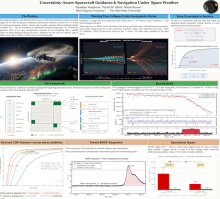
Thermospheric density is the dominant error source in low-Earth orbit prediction, yet density model uncertainties are seldom propagated through to the orbital quantities that drive operational decisions. Geomagnetic storms can enhance densities by factors of 2-5× within hours, and even during quiet times empirical models disagree by 20-40% but these uncertainties typically stop at the density level without reaching downstream orbital risk. The May 2024 G5 Gannon storm illustrates the consequence: KANOPUS-V 3 experienced 917 m of semi-major axis decay within days, exposing how quickly storm-driven density errors can cascade into collision avoidance challenges, premature reentry risk, and station-keeping violations.
We present a framework that bridges this gap by mapping any calibrated density uncertainty envelope into orbital impact. The approach propagates multiplicative density and ballistic coefficient uncertainties (δρ, δB) through drag-specialized Gauss Variational Equations via an augmented state-covariance system, producing first-exit time distributions: the probability that along-track drift exceeds a prescribed tolerance as a function of time. This reframes the question from "how much will the orbit decay?" to "how much warning do I have?” a quantity directly relevant to maneuver planning. We demonstrate the framework on constellation station-keeping, where G5-level density uncertainty reduces median time-to-violation from days to hours.
The framework is density-model agnostic, currently baselined with NRLMSISE-2.0. Ongoing work will integrate the Reduced Order Probabilistic Emulator (ROPE), a data-driven thermospheric model developed at ASSIST Lab, West Virginia University that provides storm-resolved density distributions enabling a direct pipeline from calibrated space weather research to downstream orbital impact assessment.
We present a framework that bridges this gap by mapping any calibrated density uncertainty envelope into orbital impact. The approach propagates multiplicative density and ballistic coefficient uncertainties (δρ, δB) through drag-specialized Gauss Variational Equations via an augmented state-covariance system, producing first-exit time distributions: the probability that along-track drift exceeds a prescribed tolerance as a function of time. This reframes the question from "how much will the orbit decay?" to "how much warning do I have?” a quantity directly relevant to maneuver planning. We demonstrate the framework on constellation station-keeping, where G5-level density uncertainty reduces median time-to-violation from days to hours.
The framework is density-model agnostic, currently baselined with NRLMSISE-2.0. Ongoing work will integrate the Reduced Order Probabilistic Emulator (ROPE), a data-driven thermospheric model developed at ASSIST Lab, West Virginia University that provides storm-resolved density distributions enabling a direct pipeline from calibrated space weather research to downstream orbital impact assessment.
Poster PDF
Poster session day
Poster location
4
Meeting homepage