Building Leaders, Building Community: A Look Back at the 2026 Early-Career Leadership Program Workshop
Each year, the Early-Career Leadership Program (ECLP) gives a cohort of NSF NCAR | UCAR | UCP staff the chance to step back from their day-to-day work and invest in something different: themselves, as future leaders. Open to employees across every job category — scientists, engineers, technicians, administrative staff, and educators alike — the program is designed to build skills in effective communication, team collaboration, and creative scientific thinking, while helping participants forge a network of colleagues from across the organization. This year's cohort of roughly 25 early-career staff ran the full course, from virtual sessions beginning March 2 through an in-person capstone April 7–9, 2026, in the Mesa Lab Library.
The structure reflected the program's deliberate, six-week pacing: three virtual sessions held every other Monday, with small groups meeting independently in the weeks between, followed by three full days together in Boulder. As CPAESS scientific staff Ben Trabing, Scientist at the National Hurricane Center (NHC); Rachel Gulbraa, Writer | Editor at the NOAA Office of Ocean Exploration; and Allie Brannan, Scientist at the National Hurricane Center (NHC) all agreed, the virtual sessions laid important groundwork, but the real heart of the experience happened once everyone was in the same room. "I think the online component was helpful, but I don't think it was as helpful in person," Ben reflected. "If we had just done the remote component, I don't think I would have gotten as much out of it."
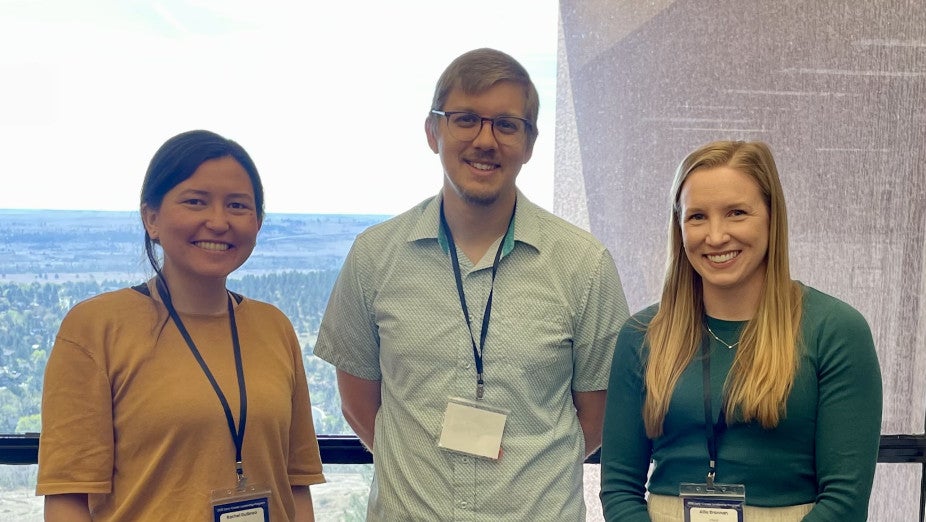
Rachel Gulbraa, Ben Trabing, and Allie Brannan
The three in-person days were carefully structured, moving participants through a sequence of themes designed to build on one another. Tuesday opened with sessions on transitioning from contributor to leader and on emotional intelligence, before turning in the afternoon to personal development and strategies for maintaining well-being and avoiding burnout. Wednesday shifted toward communication and team dynamics, covering effective communication, navigating hierarchical structures, delegation and accountability, and time and energy management. Thursday brought it all together with a discussion alongside Everette Joseph and Rebecca Haacker, sessions on self-advocacy and overcoming imposter syndrome, and a closing reflection and graduation.
For Ben, the experience was grounding from the start, simply by being around peers navigating the same career stage. "It was really grounding to see all of the other early career professionals... we were all kind of in the same boat," he said. "It's also just really nice getting with all the groups and doing all these different activities... I learned a lot about myself."
Rachel echoed that sense of grounding, describing how meaningful it was to reconnect with the physical place she'd worked for so long, even while immersed in a packed agenda. There was “something about the physical landscape and buildings that made it feel a little bit more real and particular in this moment," she said. She also found the content surprisingly resonant on a personal level, particularly since she has worked to build interpersonal and public speaking skills since the pandemic.
Allie, who had never taken the CliftonStrengths assessment before, found that both the assessment and the workshop content exceeded her expectations. "I found the content to be better than I was expecting," she said. "The examples and the exercises were really tangible, and they gave very clear examples of how to be better leaders." She and Ben were surprised by how accurately the assessment captured their strengths. "It nailed me," Allie said. "I don't know — the kind of algorithm under the hood was pretty good."
Beyond the structured content, the cohort found real value in simply getting to know one another. Rachel pointed to networking as a quieter but lasting benefit of the program. "There's value just with that sort of networking and knowing other humans component, because we're all in the same area even if we're not working on the exact same projects," she said. "The kind of unanticipated value down the line — I think it's going to be really hard to tally, but it exists and will exist." Ben put it more simply, describing the kind of connection he'd love to see scaled up across the broader CPAESS community: "kind of like a CPAESS symposium with lightning round talks from all the groups."
All three participants left the workshop hoping the opportunity wouldn't be limited to a small, early-career cohort. "I would love the whole team to take it," Allie said. "I think everybody could learn something from it." Rachel agreed, suggesting that even a scaled-down version — informal introductions, quick talks about each person's work, and facilitated conversation — could help bridge the gap between CPAESS's more than 100 scientists, who are often distributed across federal partner sites and rarely have the chance to connect.
That distributed structure is part of what makes CPAESS unique, and part of why opportunities like the ECLP carry extra weight. The immediate takeaway was clear: time spent building self-awareness, communication skills, and genuine connections with colleagues is time well spent. As Rachel put it, reflecting on the workshop's lasting value, "It could be a good way to kind of just build those foundations and solidify those relationships."