NASA Jack Eddy Fellow Prateek Mayank Honored with Justice Oak Award
NASA Jack Eddy Postdoctoral Fellow Prateek Mayank was selected to receive the Justice Oak Award for Outstanding Thesis in Astronomy by an Indian student. Awarded by the Astronomical Society of India (ASI), the honor encourages excellence among students engaged in research in India.
Mayank completed his PhD at the Indian Institute of Technology (IIT) Indore under the Prime Minister’s Research Fellowship, India’s most prestigious fellowship.
His thesis, Modeling the Evolution and Impact of Space Weather Drivers (PDF), reinforces that space weather – conditions on the sun and in space that can interrupt modern technologies in use on Earth – has become increasingly important. Space weather can generate electromagnetic fields resulting in currents capable of disrupting power lines or causing power outages. More severe space weather produces enough magnetic energy to damage satellites involved in communications, GPS, and can impact weather forecasting on Earth.
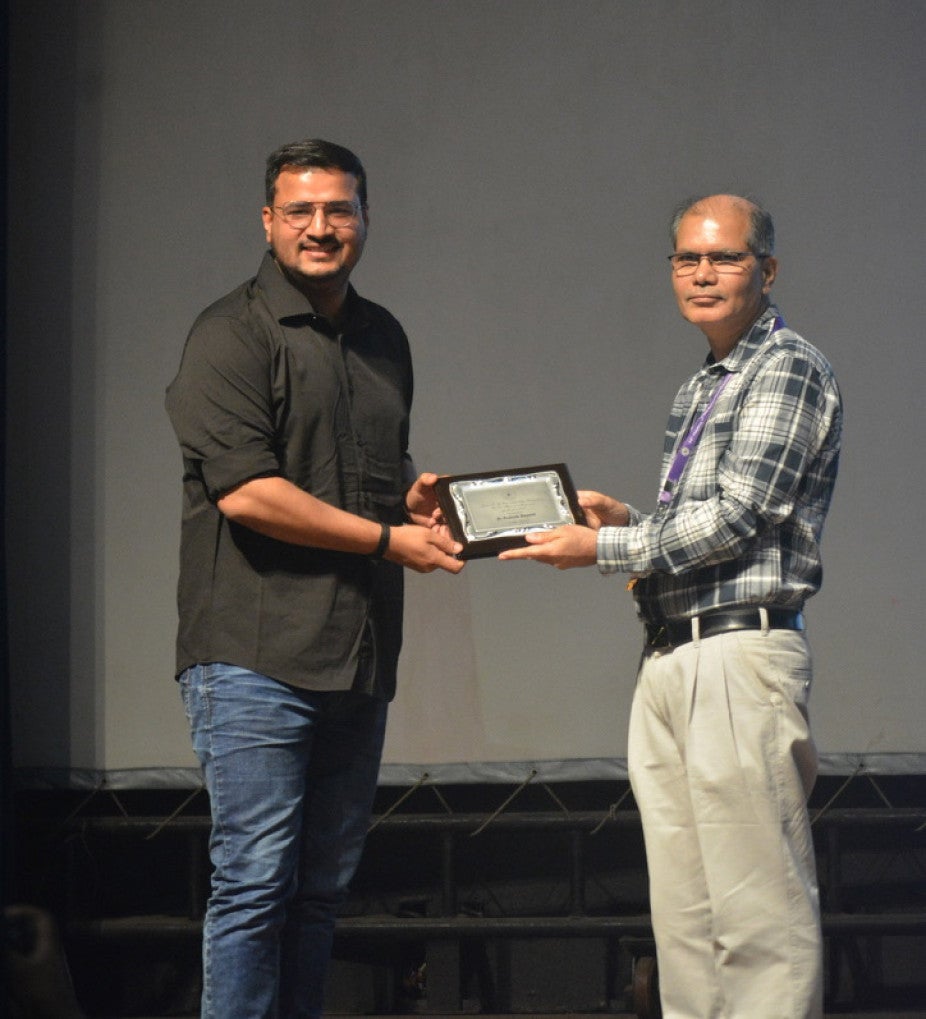
Prateek Mayank accepted the Justice Oak Award for Outstanding Thesis in Astronomy at the 44th Meeting of The Astronomical Society of India, May 15-19, 2026.
Credit: P. Mayank
“Dr. Mayank’s thesis work is distinguished by its ambition and successful execution. He developed the SWASTi (Space Weather Adaptive SimulaTion) framework, which provides the foundation for the first Indian physics-based global solar wind and magnetized Coronal Mass Ejection (CME) models,” wrote Dr. Dibyendu Chakrabarty, Professor and Principal Investigator of the Solar wind Particle Experiment (ASPEX) onboard India's Aditya-L1 satellite, in his nomination letter. “His work comes at a critical time, providing simulation support for the science with Aditya-L1 observations.” Aditya-L1 is India’s first space-based mission to study the Sun.
Chakrabarty had followed Mayank’s research because he tackled a challenging problem in heliospheric physics. Chakrabarty noted that while many doctoral students use existing models to support their research, Mayank built his own, making his contributions unique.
The SWASTi framework combines observational data with physics to model solar wind and CME occurrences in inter-planetary space. Together, they allow for significantly higher fidelity in predicting the “geo-effectiveness of storms” or a storm’s likelihood of causing disruptions on Earth according to Chakrabarty.
Importantly, Mayank demonstrated that high-density trailing CMEs – plasma that trails behind a solar magnetic eruption characterized by its rope-like appearance – result in more severe impacts and identified that strong interactions can induce reverse shocks, extending the duration of geomagnetic storms.
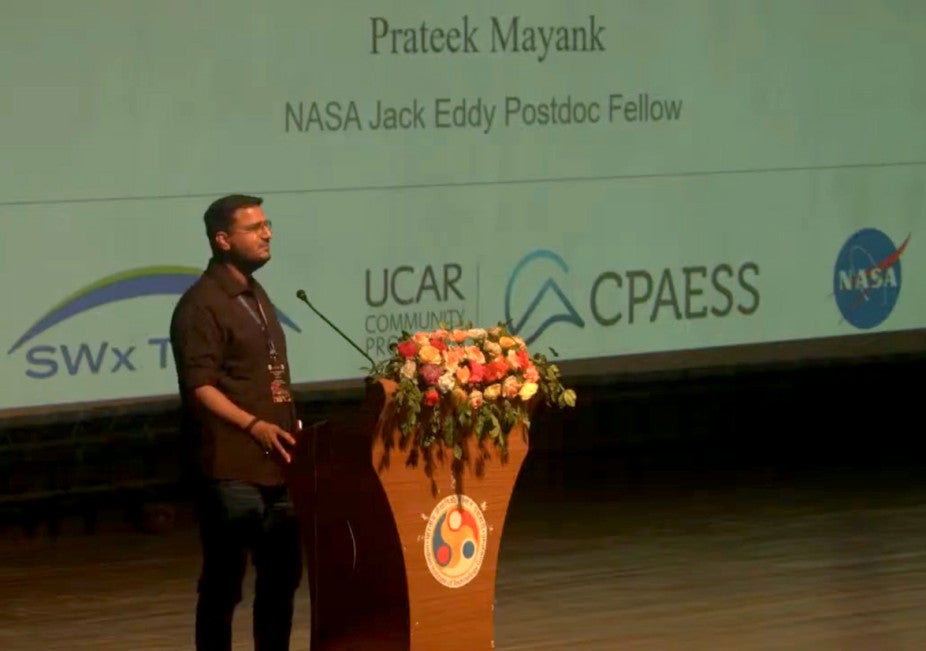
NASA Jack Eddy Fellow Prateek Mayank spoke at the NASA 5th Eddy Cross-Disciplinary Symposium held in Boulder, CO, May 2026.
Credit: P. Mayank
In addition to the Justice Oak Award, Mayank received the Best Paper Award at the National Space Science Symposium (NSSS 2024) and the Scientific Committee on Solar-Terrestrial Physics (SCOSTEP) Visiting Scholar Award.
His research has resulted in several peer-reviewed publications in journals such as The Astrophysical Journal Supplement Series, The Astrophysical Journal, and Solar Physics.
Mayank’s NASA Jack Eddy Postdoctoral Fellowship, administered by UCAR | CPAESS, builds on his dissertation. In the course of his PhD work, he encountered several bottlenecks to accurate forecasting and is addressing them through a hybrid approach that involves artificial intelligence (AI) and physics for improved results.
“I was honored to receive the Justice Oak Award and then, to be selected for the Jack Eddy Fellowship,” said Mayank. “I had tremendous support from mentors and research groups, and this is so important as inspiration for upcoming PhDs.”
Mayank is aiming to eventually return to India to continue his research and lead a research group of his own.
Don't miss Prateek's CPAESS Discovery Seminar on "How AI is Transforming Solar Wind Research and Forecasting"
Watch Prateek Mayank's Recording.