A Universe of Free Learning: New Heliophysics Courses Join CPAESS's Growing Resource Library
For nearly two decades, CPAESS has been quietly building one of the richest free educational archives in heliophysics — and now, that wealth of material has a clear new front door. NASA's Living With a Star Program and CPAESS partnered in 2006 to launch the Heliophysics Summer School, and over the 20 years since, CPAESS has compiled an extensive set of lecture materials spanning every domain of heliophysics and related fields — from solar and stellar interiors to planetary atmospheres, plasma processes, particle acceleration, and the instrumentation used to observe it all.
That archive has long lived as a deep but sprawling library: presentations and video recordings sorted by year, speaker, theme, and textbook, alongside interactive labs and problem sets contributed by respected leaders across heliophysics subdisciplines since 2007. It's an extraordinary resource — but for someone new to the field, knowing where to start may not be entirely obvious.
That's where the new Heliophysics Courses come in. A subset of the Summer School's online materials has now been organized into three structured learning pathways, each designed to provide a clear, guided introduction to the field's foundational principles.
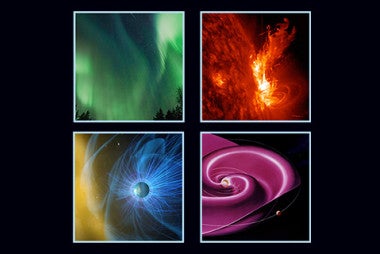
The first pathway, Heliophysics by Domain, walks learners through the field's core regions of study — solar physics and the corona, the solar wind, and planetary magnetospheres and ionospheres — while emphasizing how interconnected these domains really are, sharing the same underlying plasma processes despite often being studied separately.
The second, Heliophysics by Plasma Physics and Processes, focuses on the models and mechanisms that cut across nearly every heliophysics topic: magnetohydrodynamics, kinetic theory, particle acceleration, radiative processes, and magnetic reconnection. The third, Heliophysics by Observations and Data Sources, introduces the diverse measurement techniques the field relies on, from in-situ plasma measurements and electric and magnetic field sensing to energetic particle detection, remote imagery, and radio astronomy.
Each pathway links directly to lecture slides and video recordings, suggested readings from the Summer School textbooks, and connections to related topics within and across the other pathways — turning two decades of expert lectures into something that feels less like an archive and more like a curriculum.
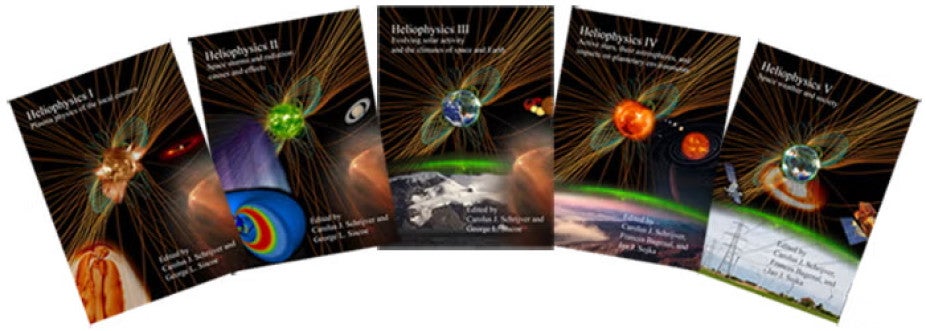
The courses are also tied closely to a set of foundational texts that have shaped the field for years. Among the recommended starting points is The Sun, the Earth, and Near-Earth Space by Jack Eddy, an overview of the processes connecting Earth to the Sun, alongside Principles of Heliophysics by Karel Schrijver and colleagues, and the landmark five-volume Heliophysics textbook series. The Heliophysics volumes, published by Cambridge University Press, compile chapters written by the original Summer School lecturers, while Principles of Heliophysics distills many of the field's most important unifying ideas into a free e-book available through arXiv.
Importantly, the new courses don't replace the broader resource library — they sit on top of it, offering a way in. The full Summer School collection remains freely available, including presentations sorted by textbook, year, speaker, and theme, along with labs and problem sets going back to 2007. Whether someone is a student encountering heliophysics for the first time, a faculty member looking to supplement university course content, or simply a curious learner working through the pathways on their own, the full package — courses, lectures, labs, and textbooks alike — is free and open to anyone.
It's a fitting evolution for a program built on the idea that understanding our star, and its influence across the solar system, shouldn't be limited to those already inside the field. With the new course pathways now guiding the way in, that knowledge is more accessible than ever.