UCAR, CPAESS Ocean Acidification Expertise Showcased at 2026 NOAA OAP Research Community Meeting
The 2026 NOAA Ocean Acidification Program (OAP) Research Community Meeting brought together government and university researchers and other community members to foster collaborations, share high-impact findings and products, and explore emerging priorities for ocean acidification (OA) research and resilience.
OA is the process by which the ocean absorbs additional carbon dioxide (CO2) from the atmosphere. While the ocean is not acidic, the additional absorbed CO2 changes the ocean’s chemistry by increasing its acidity. Tracking changes in OA by collecting observations that can be compared over time is crucial because more acidic waters can affect coral reefs, fisheries, other natural resources, and communities.
Talks on each of the three days were nested under an overarching theme: how ocean chemistry is changing and tools used to understand ocean change; the impacts of OA on vulnerable ecosystems and species; and human connections and looking ahead to challenges, gaps, and priorities.
UCAR | CPAESS staff involved in OA research, planning, and outreach were well-represented at the meeting, sharing their current work and expertise.
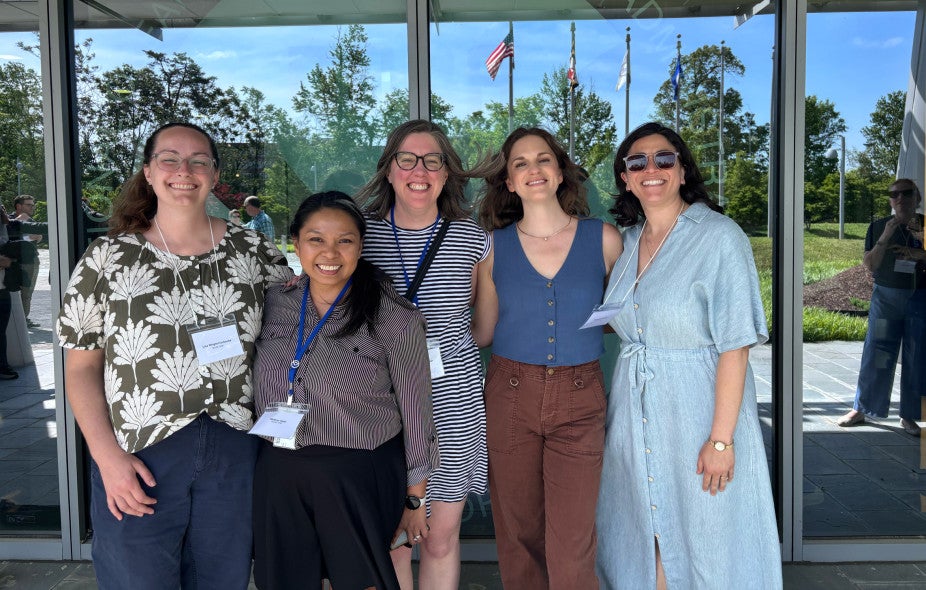
From left: UCAR | CPAESS | NOAA staff Liza Wright-Fairbanks, Melissa Hiatt, Heather Heenehan, Kaity Goldsmith, and Alexandra Puritz shared current work and expertise at the 2026 NOAA OAP Research Community Meeting.
Credit: H. Heenehan
- Kaity Goldsmith, CPAESS Program Specialist with NOAA OAP, spoke on “Advancing the NOAA Acidification Research Plan,” highlighting progress outlined in the 2025 report, A Mid-Decade Check-in: The NOAA Ocean, Coastal, and Great Lakes Acidification Research Plan 2020-2029, for which she was first author.
-
She chaired a session and also closed the meeting with a talk on OAP’s outlook for the future as outlined in the FY27-29 NOAA Ocean Acidification Program Strategic Science Prospectus. The prospectus reviews NOAA’s OA investment portfolio, identifying new priority areas and necessary adjustments to ensure [NOAA] science remains responsive to emerging needs.
-
- Heather Heenehan, CPAESS Outreach and Education Specialist, along with Liz Perotti, NOAA OAP, addressed OA engagement in their talk, “Bringing OA to the Forefront: Communication Best Practices and National Outreach through Education.”
- Melissa Hiatt, CPAESS Web Developer with NOAA OAP, presented a poster on, “Making Ocean Acidification Science Discoverable” and ran technology support throughout the meeting.
- Alexandra Puritz, CPAESS Program Specialist with NOAA OAP, lent her program management expertise as one of the meeting organizers and chaired a session.
- Liza Wright-Fairbanks, CPAESS Program Specialist with NOAA OAP, chaired a session.
Opportunities like the NOAA OAP Research Community Meeting provide a forum for researchers and other interested stakeholders to share and improve the understanding of OA and build partnerships to better prepare society to respond to ocean, coastal, and Great Lakes acidification.