Celebrating 20 Years of the NASA Heliophysics Summer School: Building a Legacy of Science, Education, and Community
For 20 years, the NASA Heliophysics Summer School has brought together the next generation of heliophysicists with some of the field's leading scientists to explore the interconnected physics of the Sun, solar system, and space environment.
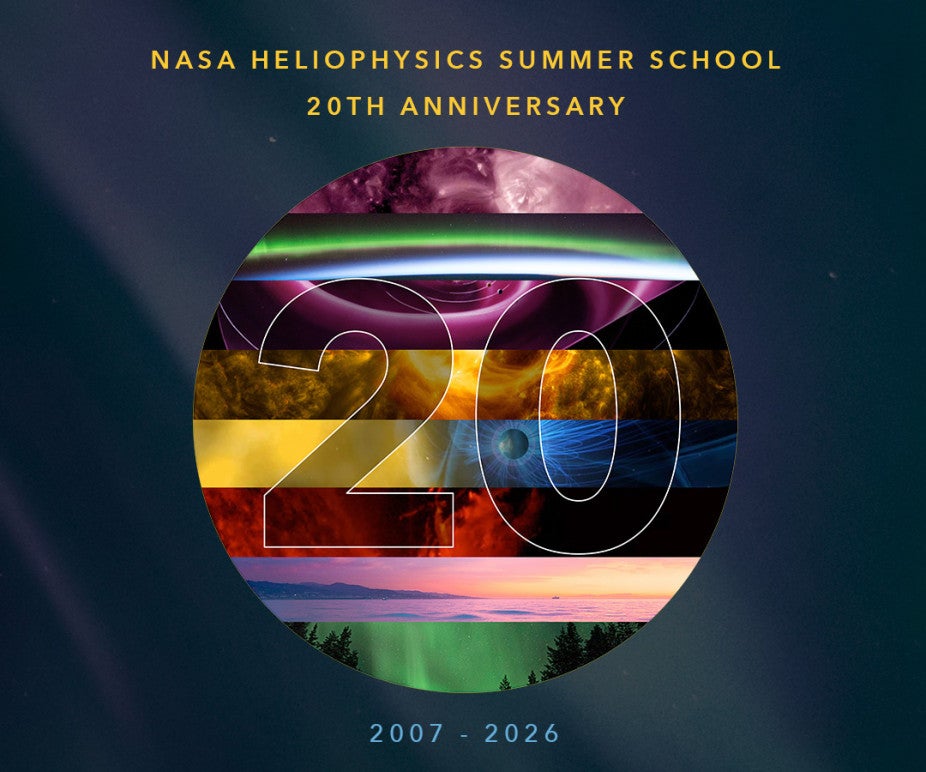
20th Anniversary of NASA's Heliophysics Summer School poster art
Credit: CPAESS
This July, that legacy was celebrated in Boulder, Colorado, as the 20th NASA Heliophysics Summer School brought together early-career scientists for a week of learning, collaboration, hands-on activities, and scientific discovery.
But the milestone was about more than one week in July. Over two decades, the Summer School has grown into a lasting educational resource for the heliophysics community—producing textbooks, lectures, video lessons, laboratory exercises, problem sets, courses, and other materials that continue to reach students and educators around the world.
Celebrating Two Decades of Heliophysics
The 2026 Summer School officially began with a special 20th Anniversary Celebration on July 20 at UCAR's Center Green in Boulder.
The celebration brought together Summer School participants, faculty, alumni, and members of the broader heliophysics community for an evening of networking, hors d'oeuvres, and a special panel discussion reflecting on the history and future of the program.
The anniversary panel featured an extraordinary group of scientists and leaders whose careers have helped shape modern heliophysics:
- Madhulika (Lika) Guhathakurta, Senior Advisor at NASA Heliophysics and founder of the NASA Heliophysics Summer School
- Thomas Bogdan, Research Scientist at the National Solar Observatory
- Amitava Bhattacharjee, Professor at Princeton University
- Marco Velli, Professor at UCLA
- Farzad Kamalabadi, Professor at the University of Illinois Urbana-Champaign
- Fran Bagenal, Professor at the University of Colorado Boulder and Senior Research Scientist at LASP
- Nicolas Gross, Senior Research Scientist at Boston University and the NASA SHIELD Center
- Andrés Muñoz-Jaramillo, Lead Scientist at Southwest Research Institute and former NASA Jack Eddy Postdoctoral Fel
The panel offered a chance to look back at how heliophysics has evolved over the past two decades while also considering where the field—and the scientists entering it today—is headed next.
That spirit of looking both backward and forward was particularly fitting for a program that has always emphasized connections: connections between different areas of heliophysics, between observations and theory, and perhaps most importantly, between scientists.
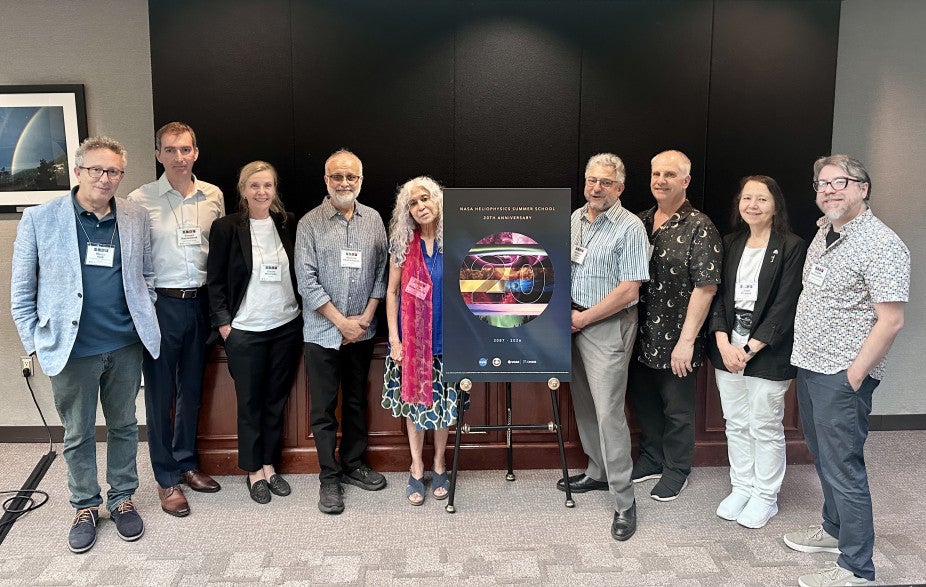
20th Anniversary panel
Credit: CPAESS
A Legacy That Extends Far Beyond Summer School
Perhaps one of the most remarkable accomplishments of the NASA Heliophysics Summer School is that its impact doesn't end when participants return home.
Since the program began in 2007, its faculty and organizers have built an extensive collection of educational materials. Presentations, recorded lectures, interactive laboratories, problem sets, and other resources from Summer Schools dating back to 2007 are now available online, free of charge. The materials are designed not only for Summer School participants, but also for students, faculty, educators, and universities around the world.
The program has also produced a landmark series of Heliophysics textbooks.
The series includes:
- Heliophysics I: Plasma Physics of the Local Cosmos
- Heliophysics II: Space Storms and Radiation: Causes and Effects
- Heliophysics III: Evolving Solar Activity and the Climates of Space and Earth
- Heliophysics IV: Active Stars, Their Astrospheres, and Impacts on Planetary Environments
- Heliophysics V: Space Weather and Society
The books grew directly from the multidisciplinary material developed through the Summer School and are designed to help students and educators approach heliophysics as a connected discipline rather than as a collection of isolated specialties.
Other resources include The Sun, the Earth, and Near-Earth Space by Jack Eddy, a gentle overview of the processes connecting the Earth to the Sun; and Principles of Heliophysics by Karel Schrijver et al. which provide a free online volumes emphasizing the universal physical processes behind planetary habitability. It includes approximately 200 activities, including problems, exercises, explorations, literature readings, and “what if” challenges.
Together, these resources have helped extend the reach of the Summer School from a single annual gathering to an international educational resource.
Four New Pathways for Learning Heliophysics
That educational legacy is continuing to grow.
The Heliophysics program has now organized a portion of its extensive collection of Summer School materials into four learning pathways, making it easier for students and educators to navigate the field:
Heliophysics by Domain This pathway explores the major domains of heliophysics, including the Sun and corona, solar wind, planetary magnetospheres, and ionospheres—and emphasizes how these seemingly distinct regions are interconnected.
Heliophysics by Plasma Physics and Processes This pathway focuses on fundamental plasma processes that occur across heliophysics, including magnetohydrodynamics, kinetic theory, particle acceleration, radiative processes, and magnetic reconnection.
Heliophysics by Observations and Data Sources This pathway examines the many ways scientists observe the heliosphere, including in-situ plasma measurements, electric and magnetic fields, energetic particles, remote imagery across the electromagnetic spectrum, and radio astronomy.
Machine Learning and Heliophysics Reflecting the theme of the 2025 and 2026 Summer Schools, this pathway brings together lectures and activities focused on data-driven approaches and machine learning applications in heliophysics.
Each pathway connects lecture slides and video recordings with suggested readings from the Summer School textbooks and links to related topics, creating a flexible way for students to explore heliophysics at their own pace.
A Resource for the Global Heliophysics Community
The legacy of the NASA Heliophysics Summer School is ultimately measured not only in the scientists who have attended, but also in the knowledge that continues to be shared.
A student in one country can watch a lecture recorded during a Summer School in Boulder. A professor at a university on the other side of the world can use a Summer School laboratory or problem set in a course. An early-career researcher can turn to the textbook series for a broader perspective outside their own specialty. And a new generation of students can explore machine learning applications in heliophysics through resources created by experts in the field.
The Summer School's educational resources are available free online, making them accessible to the broader public and providing universities worldwide with materials they can use to develop or supplement heliophysics courses.
That may be one of the program's greatest accomplishments: transforming a weeklong experience into a body of knowledge that can continue teaching, inspiring, and connecting scientists for years to come.
Looking Ahead
The 20th NASA Heliophysics Summer School was both a celebration of where the field has been and a glimpse at where it is going.
Twenty years ago, the program brought together scientists to build a stronger understanding of the interconnected physical processes linking the Sun, Earth, and planetary environments. Today, a new generation is combining that foundational understanding with unprecedented observations, massive datasets, and emerging computational tools.
For 20 years, the NASA Heliophysics Summer School has helped build that future—one student, one lecture, one experiment, and one scientific connection at a time.
And its legacy is now available for anyone to explore.