CPAESS scientist explores improvements to Navy global forecast system
A recent study by Marcela Ulate, UCAR | CPAESS scientist with the U.S. Naval Research Laboratory (NRL), explores improvements to the Navy Earth System Prediction Capability (Navy ESPC), a global forecast system.

Marcela Ulate is the lead author on a new paper that explores improvements to the Navy Earth System Prediction Capability (Navy ESPC), a global forecast system.
Credit: M. Ulate
The researchers found that adding stochastic perturbations to the Navy ESPC by means of a Stochastic Kinetic Energy Backscatter (SKEB) scheme improved the system’s representation of forecast uncertainty and reduced forecast error. The approach also showed improvements in forecasting of the Madden-Julian Oscillation (MJO) as well as ocean conditions. The study was published in Weather and Forecasting.
SKEB is a process that introduces small perturbations, or differences, into the model to represent the uncertainties in precipitation that are not fully captured by one forecast. Numerical weather prediction models like the ESPC tend to underestimate uncertainty due to limited observations and as a result, can be over confident. (Source) Running multiple versions of the model allows researchers to better represent and understand the range of possible outcomes.
“Using SKEB we can account for observation uncertainties or missing data and assess how these changes affect model performance,” said Ulate.
Operationally, the Navy ESPC produces forecasts extending from one week to 45 days and consists of four main models: atmosphere, ocean, sea ice, and surface wave. By incorporating data about the state of the atmosphere, ocean, sea ice, and surface waves, the Navy ESPC delivers forecasts that are vital for tracking tropical cyclones, planning safe routes for ships and submarines, navigating sea ice, and providing wave forecasts for maritime operations in the event of rough seas.
To test improvements, researchers used an ensemble version – a collection of slightly different model runs. "The ensemble consists of lower-resolution versions of the Navy ESPC operational model that are run 16 times with slightly different initial conditions," said Ulate. Results from the SKEB version of the Navy ESPC 30-day ensemble model were compared to a control version for 2017.
In this experiment, Ulate specifically focused on perturbing the initial state of the atmosphere module at locations where precipitation was occurring for every ensemble member, utilizing SKEB to do so. Because convection is notoriously difficult to forecast in numerical models, she notes, these perturbations help account for errors stemming from how convection is approximated in numerical weather prediction, a process known as parameterization.
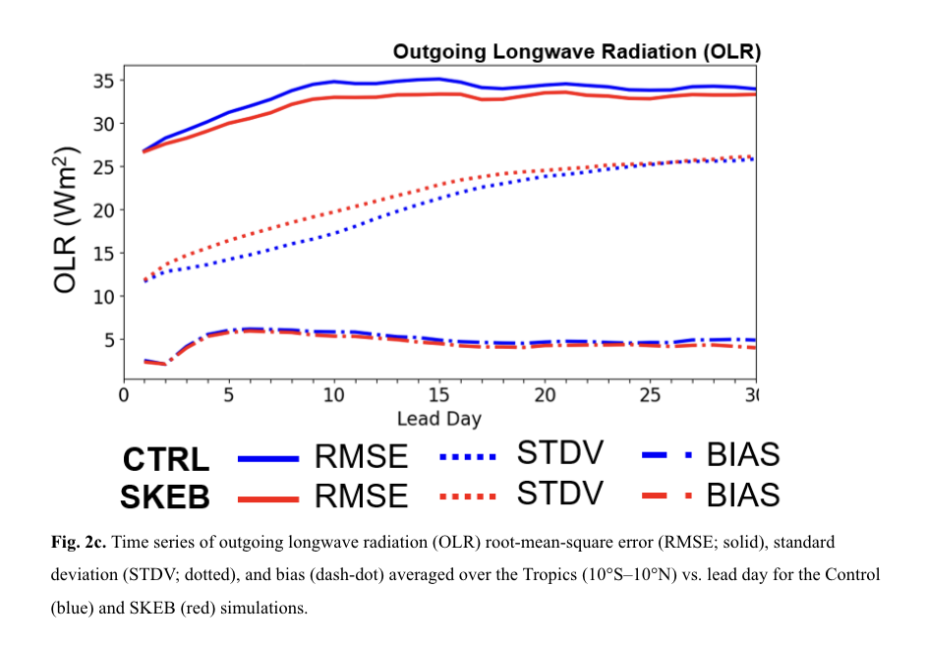
Figure 2c shows an improvement in outgoing longwave radiation (OLR), which serves as a proxy variable for convection, for simulations using the SKEB scheme. The red time series indicate a decrease in both root-mean-square error (solid lines) and bias (dash-dot lines), along with an increase in standard deviation (dotted lines) for the SKEB simulations. This trend is consistent across all variables examined in the paper Weather and Forecasting paper.
Credit: M. Ulate
This is important because precipitation and the resulting convection eventually feed back into the entire atmosphere-ocean system. Better representation of uncertainty in the atmosphere can lead to improvements in how the model predicts atmosphere and ocean conditions.
“So when we compare the operational version of the Navy ESPC and the SKEB version of the Navy ESPC, we see that we are successfully increasing that spread and reducing that error,” explains Ulate.
Improving one aspect of a model can have ripple effects. “By better representing atmospheric uncertainty in the ESPC ensemble, we also noted improved prediction of related processes such as the MJO, a large-scale pattern of tropical rainfall and atmospheric circulation,” said Ulate.
The MJO, an eastward moving circulation pattern characterized by convection in the Indian Ocean, has periods of enhanced and suppressed rainfall. (Source.) Even though it is tropical in origin, the MJO influences extreme weather around the world, including tropical cyclones, and heavy rainfall associated with atmospheric rivers on the west coast of the U.S. – thousands of miles from the tropics.
In addition, the research team noted that using SKEB in the atmospheric model translated to a better forecast in the ocean model. Ulate notes that this is not trivial because sometimes implementing changes in the atmosphere have little to no impact on the ocean.
“We wanted to see if perturbations in the atmosphere model introduced with SKEB would improve the overall performance of the Navy ESPC and what we found is that it not only improved the atmosphere model but forecasts of the MJO as well as the ocean model forecasts,” said Ulate.
While more research is needed over longer periods of time to obtain a larger sample size and more robust results, this research could contribute to improved forecasts used by Navy decision makers, the Joint Typhoon Warning Center, operational and emergency planners, and others who depend on accurate information about evolving weather, ocean, ice, and wave conditions.
This work was funded by the U.S. Navy.