NASA Heliophysics Summer School Explores the Future of Data-Driven Heliophysics
This summer, an international group of early-career scientists gathered in Boulder, Colorado, for the 20th NASA Heliophysics Summer School, held July 21–29, 2026. Hosted by NASA’s Living With a Star program and UCAR’s Cooperative Programs for the Advancement of Earth System Science (CPAESS), the annual summer school brings together Ph.D. graduate students and early-career postdoctoral researchers to explore the science of heliophysics, build connections across disciplines, and develop tools and perspectives they can carry into their research careers.
This year’s milestone program had an especially timely focus: Data-Driven Heliophysics.
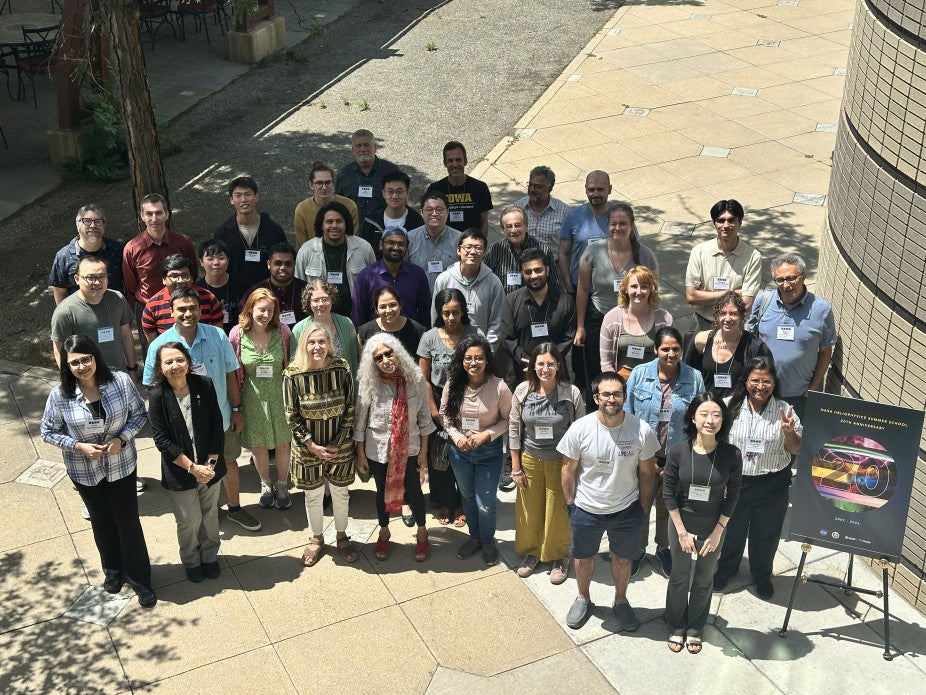
2026 NASA Heliophysics Summer School group photo
Credit: CPAESS
The theme highlighted the growing role of observations, data analysis, artificial intelligence, and machine learning in advancing our understanding of the heliosphere. Students explored how enormous volumes of data from spacecraft and ground-based observations can reveal physical processes, uncover patterns and connections, inform predictions, and ultimately deepen our understanding of the Sun, Earth, and the space environment.
The 2026 Summer School began with a celebration of its 20th anniversary, bringing together participants and members of the broader heliophysics community to mark two decades of scientific learning and collaboration.
From Heliophysics Foundations to Emerging Data Science
Throughout the week, students participated in a rich combination of expert lectures, discussions, laboratory exercises, collaborative work, and capstone activities.
The program began with a broad overview of heliophysics, including astrospheres, the solar and stellar wind, magnetic activity, magnetosphere-ionosphere systems, and plasma environments. Students then moved into the physical foundations underlying these systems, studying topics such as neutral fluids and plasmas, particle orbits, transport, heating and acceleration, and the physics of the ionosphere and thermosphere.
The observational side of heliophysics was another important component of the program. Students examined in-situ observations of particles, plasma, and fields, as well as remote sensing across the electromagnetic spectrum, including photons, polarization, imagery, video, and radio waves. They also explored data analysis and inverse problems—critical tools for turning observations into scientific understanding.
As the week progressed, the curriculum increasingly focused on the data-driven approaches at the heart of this year's theme. Students were introduced to machine learning and exploratory models, including discriminative and generative models, clustering, supervised learning, and applications of machine learning in heliophysics.
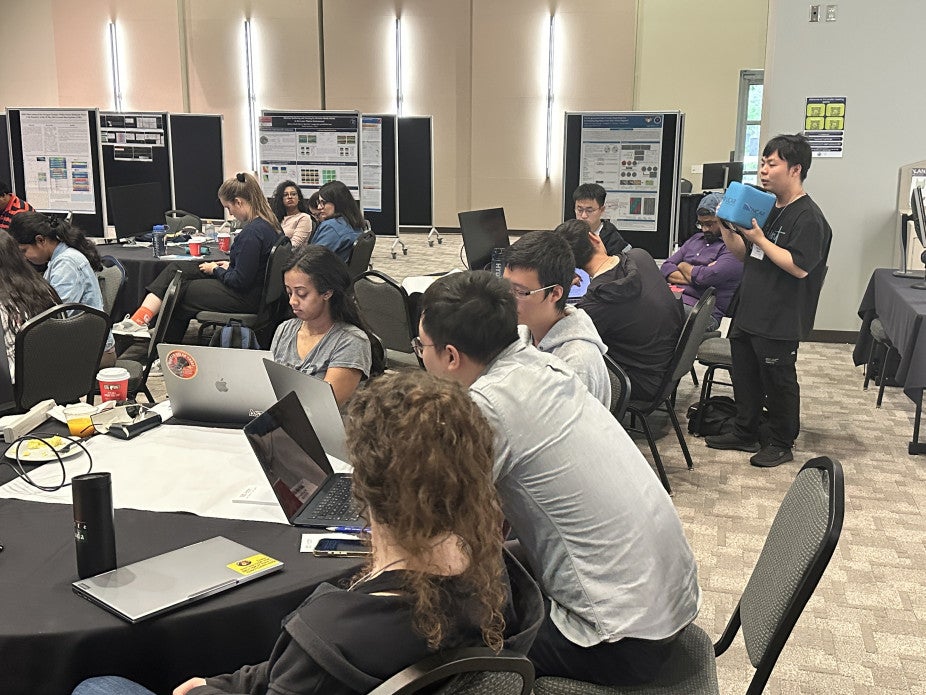
Credit: CPAESS
Learning by Doing
The Summer School wasn't just about listening to lectures.
Hands-on learning was woven throughout the program, giving students opportunities to apply new concepts and techniques to real scientific questions. Laboratory activities included analyzing a space weather event, regression and permutation analysis, clustering, and supervised learning.
Students also had the opportunity to tour UCAR's High Altitude Observatory (HAO), gaining a closer look at the people, facilities, and research that contribute to our understanding of the Sun and its influence on the space environment.
These interactive experiences helped connect the concepts presented in lectures with the practical challenges of working with heliophysics observations and data.
Bringing It All Together Through Capstone Projects
One of the highlights of the Summer School was the capstone experience, which gave students the opportunity to bring together the ideas, methods, and tools they had learned throughout the program.
Capstone work was integrated into the schedule throughout the week, culminating in final presentations on July 29. Students presented their projects to their peers and faculty, demonstrating not only their growing understanding of heliophysics but also their ability to apply data-driven approaches to scientific questions.
The final presentations were an exciting showcase of the creativity, curiosity, and scientific talent represented by this year's class.
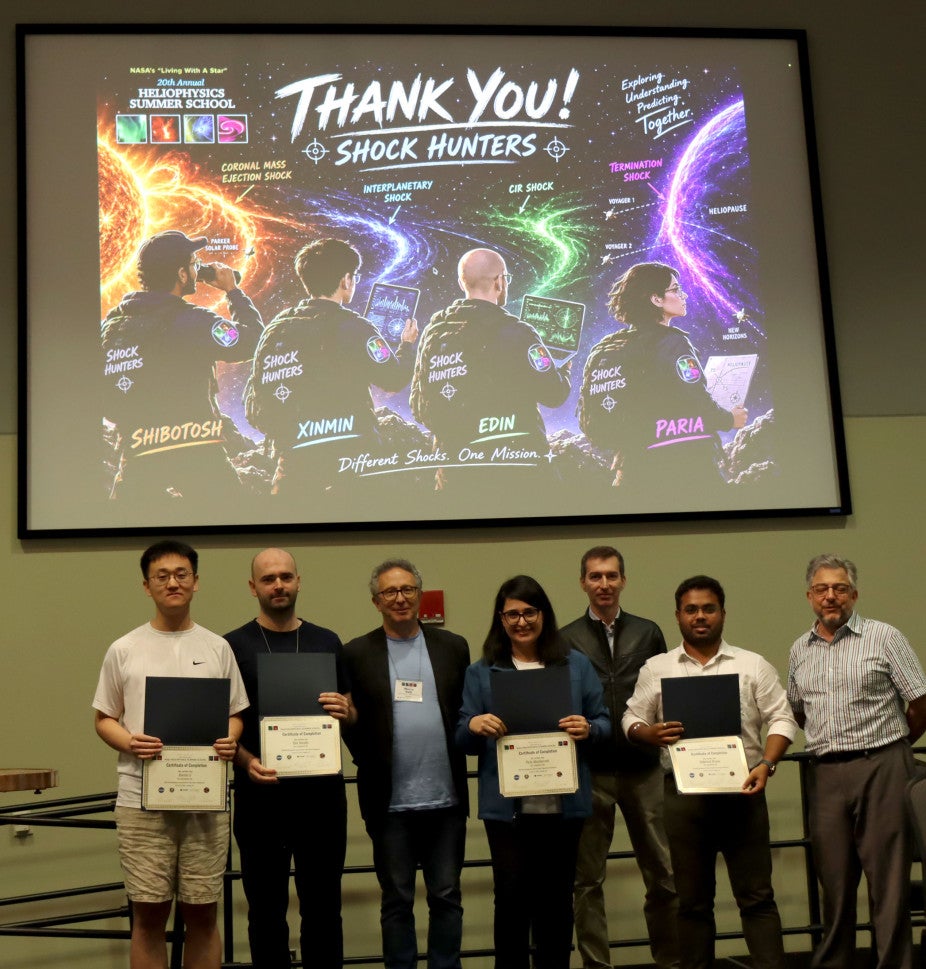
Student working group "Shock Hunters"
Credit: CPAESS
Building the Next Generation of Heliophysicists
For nearly two decades, the NASA Heliophysics Summer School has provided an important forum for early-career scientists to learn from leading researchers while building relationships with colleagues from around the world. The program is designed not only to deepen participants' understanding of Sun-Earth connections, but also to broaden the scope and impact of their research and help them develop as members of the heliophysics community.
The 20th Summer School continued that tradition while looking firmly toward the future.
As heliophysics enters an era of increasingly sophisticated observations, rapidly expanding datasets, and powerful new computational tools, the ability to connect physical understanding with data-driven methods will be essential. This year's students had a front-row seat to that evolution—and an opportunity to begin developing the skills needed to shape what comes next.
Congratulations to the 2026 NASA Heliophysics Summer School participants, faculty, organizers, and everyone who helped make this milestone 20th anniversary program a success!
To explore the 2026 Summer School presentations and recordings, visit the NASA Heliophysics Summer School website and discover the science, lectures, and resources from this year's program.