NOAA+UCAR: Tackling Climate Adaptation One Region at a Time
States are sharing information on best practices related to existing climate management and importantly, they are sharing approaches to climate adaptation in areas where the climate is changing. This is true across the U.S., but now, there is a new collaboration among states that comprise the Central Midwest: Iowa, Nebraska, Kansas, and Missouri.
From cattle to corn, this region feeds a lot of the country. “Agriculture is a really big deal here,” says Emily Rountree, UCAR | Cooperative Programs for the Advancement of Earth System Science (CPAESS) program specialist with the National Oceanic and Atmospheric Administration (NOAA). “In addition, this region is known for its storms - storms that are getting bigger and more disastrous with a changing climate, making it ever more important for regions to work together to develop adaptation strategies.”
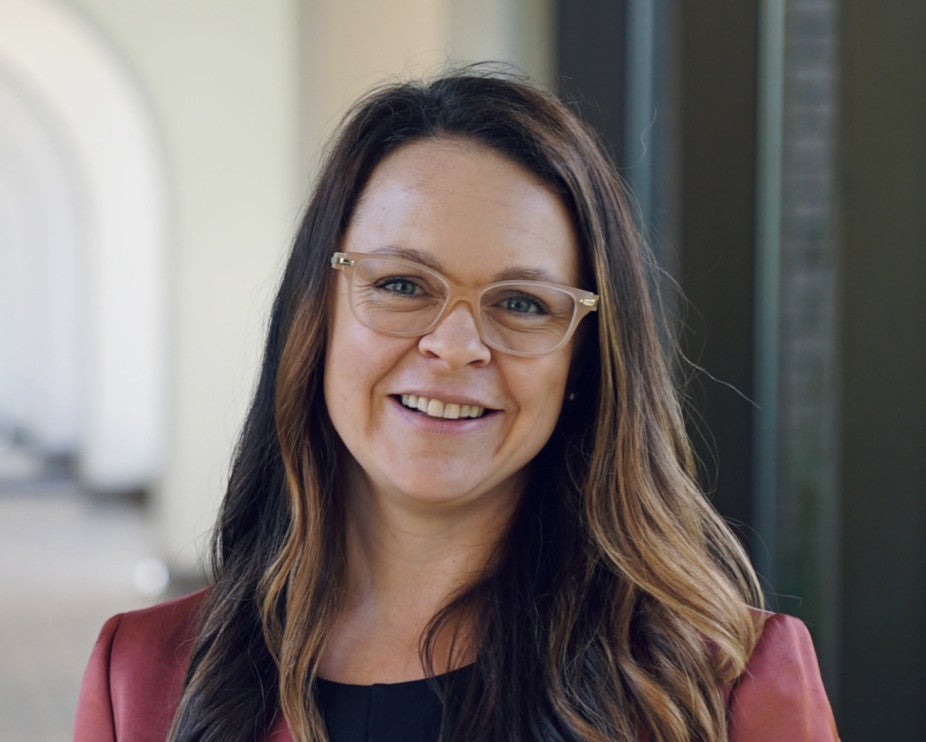
Emily Rountree, UCAR | Cooperative Programs for the Advancement of Earth System Science (CPAESS) program specialist with the National Oceanic and Atmospheric Administration (NOAA).
Credit: E. Rountree
In her position, Rountree acts as a hub or liaison, bringing together groups of like-minded researchers and professionals tackling climate adaptation planning and action and community engagement projects in their respective states so that they can learn from each other, and ideally, collaborate with each other. The partners include the NOAA Climate Adaptation Partnerships Program (formerly the Regional Integrated Sciences Assessment program or RISA), the Mid-America Regional Council, and UCAR. The new collaboration is one of 13 regional networks formed by NOAA.
One of the costliest thunderstorms in U.S. history swept through the Midwest in 2020. It produced a derecho – characterized by life-threatening, straightline winds of up to 140 miles per hour – that swept through portions of Iowa, obliterating crops in its path. NOAA estimated that it left behind $11 billion in damage.
“Because of the COVID-19 pandemic and other global concerns, this extreme storm did not really get huge attention,”says Rountree. “But 70% of the trees in Cedar Rapids, Iowa were uprooted during that storm, so I think it’s a good idea to not fly over the Midwest when it comes to climate events. There is a lot going on.”
Rountree earned masters and doctorate degrees at Colorado State University in the human dimensions of natural resources – how people affect the environment and vice versa. A big part of her work has been encouraging community engagement through service learning. Over time, she shifted more towards programs in climate and climate adaptation. Along the way, she fostered and built relationships making her a perfect fit for the requirements of the new role with UCAR and NOAA.
Zeroing in on climate events while leaning on her service learning background, Rountree has organized a new speaker series called “The Central Midwest Adaptation Conversation” that is set to launch in early 2026. She borrowed the model from a similar program at the University of Kansas where she was associate director for the Center for Service Learning.
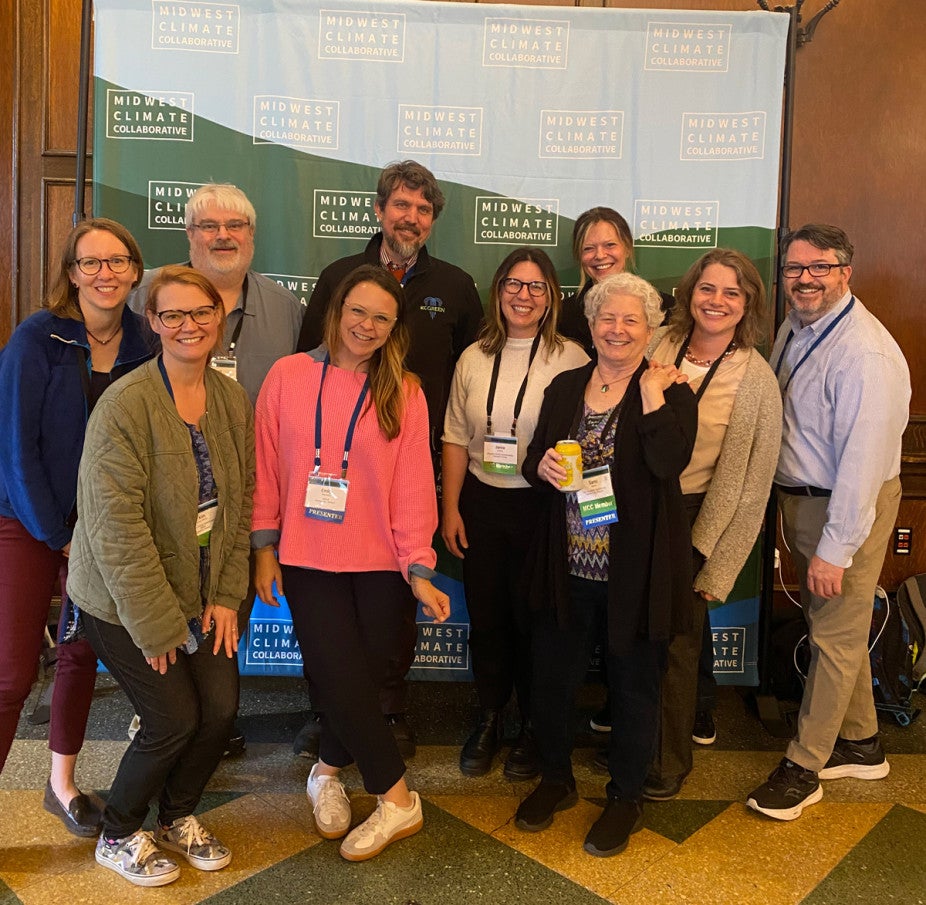
Emily Rountree (front row, second from left), along with other presenters at the Midwest Climate Collaborative.
Credit: E. Rountree
The format invites four speakers from different sectors – universities, nonprofits, government programs, cities, both urban and rural – to deliver lightning talks of less than seven minutes around a defined topic in a visual, storytelling format called PechaKucha. “You get a dynamic look at one topic that sparks fruitful and rich conversations,” says Rountree. The first round of talks highlighted initiatives supporting rural and small cities.
A future session on drought will invite the cities of Lincoln, Nebraska and Hays, Kansas, both of which are experiencing drought conditions that affect water supplies, to share their adaptation plans. “Lincoln gets its water from the Platte River,” notes Rountree. Recent droughts have reduced streamflow in the Platte River, necessitating an investigation of ways to ensure the region has a sufficient water supply. (Source.)
Likewise, Hays, Kansas is situated in an arid region. “They are not located east enough to benefit from some of the rains around Kansas City, nor are they west enough to get their water from the Ogallala Aquifer,” says Rountree. As a result, on-going drought in the region prompted the city to seek funding to develop a sustainable, long-term water supply for the county. In May 2025, the City of Hays was awarded a grant of nearly $16 million to do so.
Bringing these two cities together – along with their managers, hydrogeologists, researchers and others – to share concrete plans and progress towards adapting to a changing climate may benefit other cities grappling with similar challenges.
Subsequent talks will extend into spring and summer 2026 and focus on supporting frontline communities, as well as topics related to heat, flooding, and health impacts.
Beyond the speaker series, Rountree has partnered with the Kansas Data Science Consortium to distribute a call to the four states for new projects and to make water and climate data available to groups embarking on adaptation projects. In addition, she has enlisted the help of a graduate student to conduct a qualitative analysis of 16 existing climate action plans for the Central Midwest.
“Our goal is to release a product that will serve as an aid to the four states, all of which are dealing with similar, yet different, variations in climate,” says Rountree. They are analyzing innovative solutions and common themes to addressing climate change that will be of use to city planners, urban sustainability directors, and others.
Rountree is in the second of a three-year appointment and is aiming to set up practical tools that others can quickly use and adapt to their needs.
Informal feedback based on conversations with partners and mentors indicates that Rountree is supporting NOAA’s mission to share research, data, information, and knowledge for use by Central Midwestern communities as they partner to navigate the landscape of climate adaptation.
“It was smart for NOAA, the Mid-America Regional Council, and UCAR | CPAESS to come together around this type of collaboration,” said Rountree.
The move to expand “collaborative research and community engagement projects for climate adaptation planning and action in the Central Midwest” is advantageous for everyone.
CPAESS Discovery Seminar
On November 19, 2025, Emily Rountree gave a CPAESS Discovery Seminar presentation "Federal to Local Partnership Collaborations as We Adapt to Future Climate Risk in the Central Midwest" Watch Emily's' seminar recording