WINGS Fellow Successfully Defends, Publishes Research on Origin of Monsoon Onset Vortex (MOV)
The Indian Summer Monsoon, active from June to September, delivers about 80% of India’s annual rainfall in just four months. In late May or early June, just ahead of the core monsoon period in July and August, atmospheric conditions are sometimes perfect for the formation of a whirling vortex over the Arabian Sea – 60% of the time in fact.
This phenomenon is called the Monsoon Onset Vortex (MOV), and it is precisely what interests Shreyas Dhavale. Results of Dhavale's MOV research were published in the Journal of the Atmospheric Sciences in November 2025. The topic is also the basis for his dissertation – successfully defended in October 2025, thereby completing the requirements for his Ph.D. in atmospheric science at North Carolina State University.
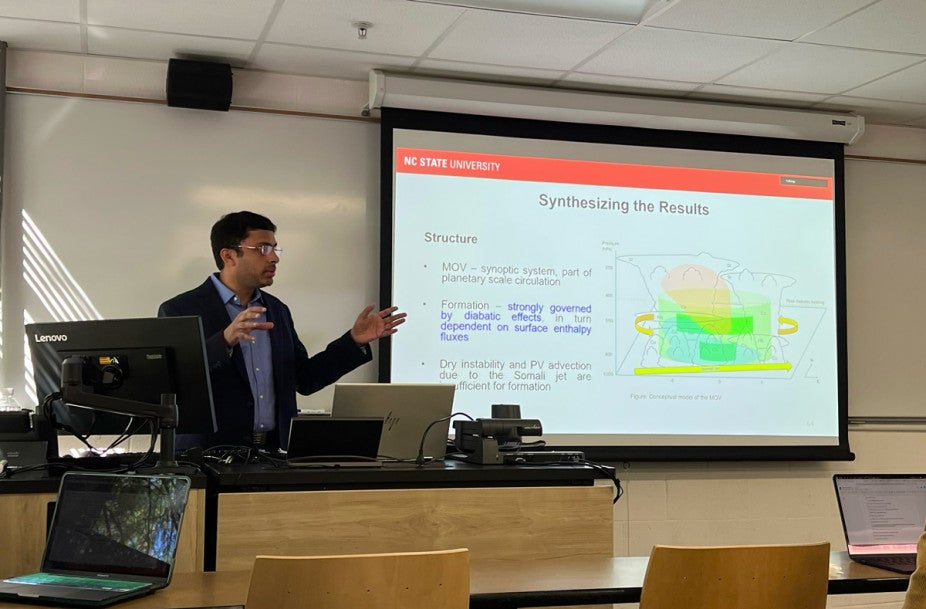
WINGS Fellow Shreyas Dhavale defended his dissertation,“The Structure and Predictability of the Arabian Sea Monsoon Onset Vortex” at North Carolina State University in October 2025
Credit: S. Dhavale
Dhavale was one of three recipients in the inaugural class of the NOAA Weather Program Office (WPO) Innovation for Next Generation Scientists (WINGS) Dissertation Fellowship that supported his research. The fellowship is administered by UCAR | Cooperative Programs for the Advancement of Earth System Science (CPAESS).
The WINGS Fellowship provided Dhavale the opportunity to learn more about NOAA’s Unified Forecast System (UFS), a schema for modeling Earth systems and to apply it operationally, aiming to improve forecasting of the MOV.
“There has not been a comprehensive study which has looked at this particular phenomenon over the last 41 years,” notes Dhavale. His research analyzed 23 cases of MOV development over that period using satellite and reanalysis data to tease out conditions that support its formation.
The MOV, says Dhavale, is responsible for bringing in – and sometimes stalling – the monsoon over Southern India and slowing or even preventing its progression over the West coast and interior of the country. In addition, MOVs frequently intensify into tropical cyclones that create hazardous conditions for the densely populated coastal regions. For this reason, it is important to understand more about the mechanism of its formation.
MOV formation is predominantly shaped by a vertical alignment of cyclonic vortices in the lower and middle troposphere that develop from shallow and deep convection over the Arabian Sea. Another contributing factor to MOV formation is a strong band of winds known as the Somali Jet or Findlater’s Jet. These winds blow off the East coast of Africa towards India at an altitude of 1.5 kilometers (.93 miles) during the monsoon. The energy from the Somali Jet helps transport moisture from the Indian Ocean and the Arabian Sea, supporting growth of the MOV and ultimately, monsoon rainfall as it pushes into India. In some years, the MOV track can prevent moisture from reaching Southern India, resulting in less rainfall during the MOV period.
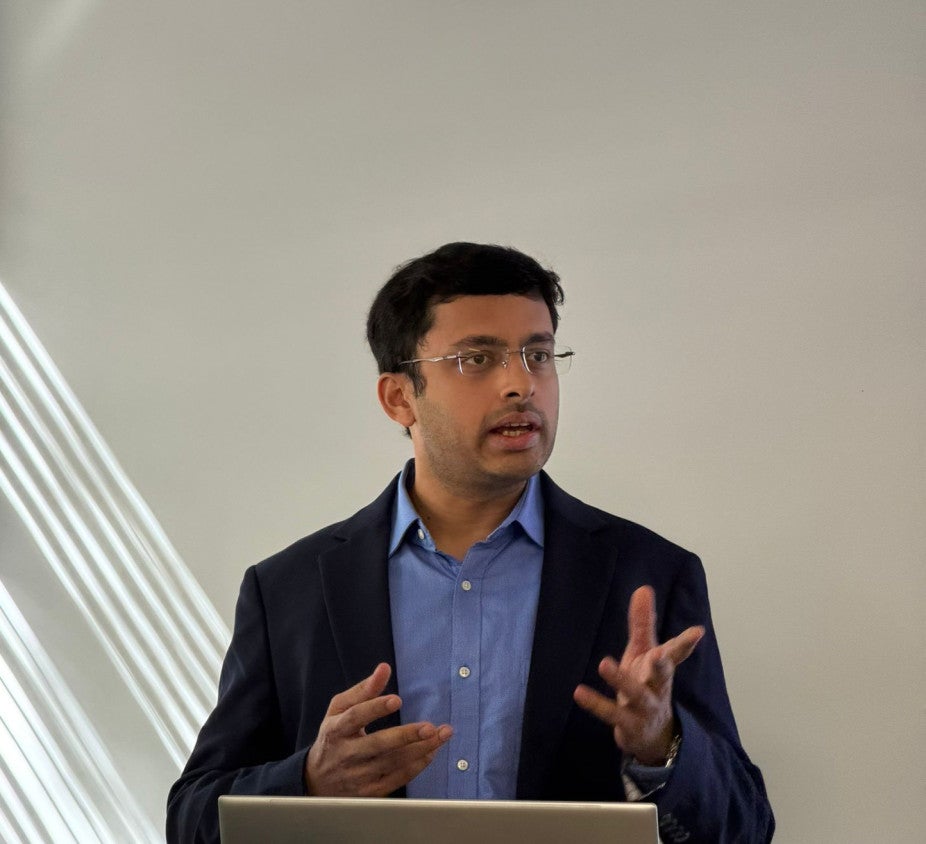
Wings Fellow Shreyas Dhavale discusses results of his research on the Monsoon Onset Vortex during his Ph.D. defense.
Credit: S. Dhavale
“One reason the research is important to me is that I was born and raised in Mumbai, India and observed the onset of monsoon every year since my childhood. I’ve seen that some years this weather system (the MOV) forms and it can disrupt the onset of the monsoon or help its onset. It is like a double-edged sword depending on its track and intensity – it can either bring the rains quickly or prevent rains from reaching the Indian coast and delay the onset of monsoon, resulting in an extended, prolonged summer.”
Dhavale notes that from humanitarian, hydrological, and agricultural perspectives it is important to know when the rainy season will start and importantly, whether its start will be slow or aggressive.
“The WINGS Fellowship has been important because it introduced me to the world of numerical modeling, specifically, the research that I conducted involved working on NOAA’s Unified Forecast System (UFS). NOAA is interested in developing new and better versions of weather and climate models to improve weather and climate forecasting. It is operationally oriented research, and this is what I find very interesting: what do we need to consider in the development of our new models?”
The fellowship opened doors for Dhavale by creating opportunities to meet NOAA scientists and make new connections across the field on topics of mutual interest. Additionally, he has presented findings at national and international meetings. He is the 2024 recipient of the John S. Irwin Award for Scientific Excellence at North Carolina State University, an award that “recognizes graduate students in atmospheric sciences who exhibit a commitment to consistent and high-quality research in meteorology.”
Dhavale is exploring post-doctoral research opportunities in tropical meteorology and numerical weather prediction. “My aim is to continue to bridge the gap between theory and prediction to solve scientific problems,” he said. “For weather prediction, that means from a very small scale to subseasonal and seasonal scales. That is my professional goal.”
CPAESS Discovery Seminar
On September 18, 2024, Shreyas Dhavale gave a CPAESS Discovery Seminar presentation "The Origin and Structure of the Arabian Sea Monsoon Onset Vortex" Watch Shreyas' seminar recording
Read more about Shreyas Dhavale’s research:
- Dhavale, Shreyas Rajendra, 2025: The Structure and Predictability of the Arabian Sea Monsoon Onset Vortex. Dissertation. North Carolina State University: https://www.lib.ncsu.edu/resolver/1840.20/45747.
- Dhavale, Shreyas and Anantha Alyyer, 2025: The Structure of a Developing Arabian Sea Monsoon Onset Vortex: Role of Moist Convection. Journal of the Atmospheric Sciences, 82 (11), 2451–2467: https://doi.org/10.1175/JAS-D-24-0212.1.
- Dhavale, S. and Anantha Alyyer, 202: The Impact of the Madden‐Julian Oscillation on the Formation of the Arabian Sea Monsoon Onset Vortex. Geophysical Research Letters, 50 (17): https://doi.org/10.1029/2023GL104156.