It Takes a Village: CPAESS Supports NOAA Arctic Report Card 2025
The National Oceanic and Atmospheric Administration (NOAA), along with national and international partners, released its Arctic Report Card (ARC) 2025. Every year since 2006, NOAA has published the ARC, a timely, peer-reviewed report on the current state of the Arctic system as compared to historical records.
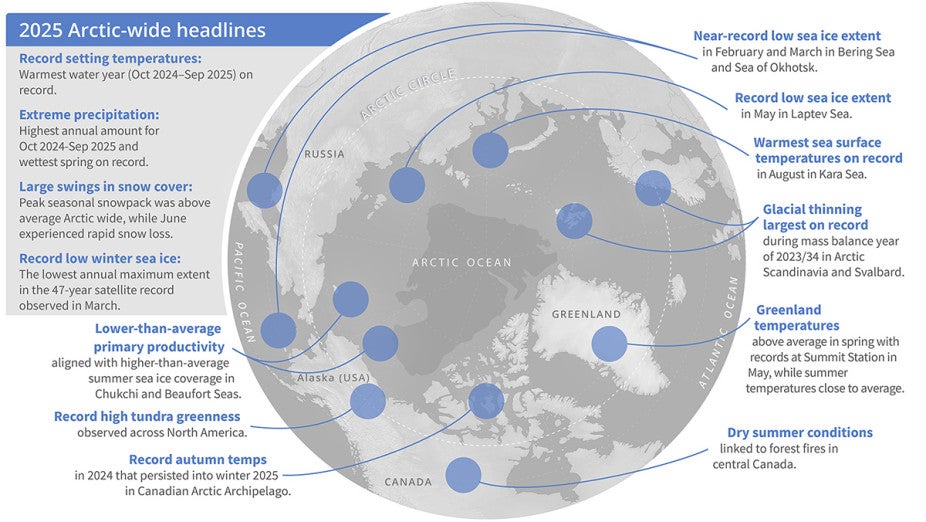
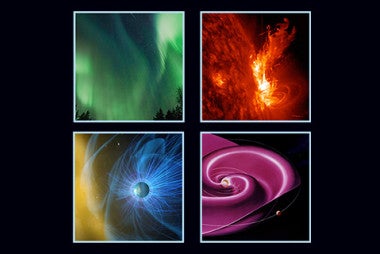
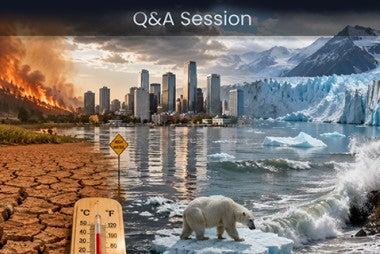
A sample from the Arctic Report Card 2025 of notable events and important topics across the Arctic.
Credit: NOAA
Producing a report of this magnitude is a heavy lift. This year there were 111 authors from 13 countries who proposed, wrote, and drew conclusions from the scientific evidence in 14 essays. Joining them was a team of experts that provided coordination, editing, website development, video production, graphic design, and communications support for the report to make it available and accessible to diverse audiences. This is a challenge because the ARC is intended for a wide audience interested in the Arctic environment and science, including scientists, decision-makers, policymakers, teachers, students, and the general public.
The Arctic Research Program within the NOAA Global Ocean Monitoring and Observing (GOMO) program, provides oversight for the annual creation of the ARC. This year, GOMO | Arctic Research Program Knauss Fellow Mary Beth Armstrong is the coordinating editor for the ARC. Heather Heenehan and Melissa Hiatt, UCAR | Cooperative Programs for the Advancement of Earth System Science (CPAESS) and Jessica Mkitarian – all of whom work on GOMO Communications – provide support for the Arctic portfolio including efforts to expand the reach and impact of the ARC.

Left to Right: Heather Heenehan, Jessica Mkitarian, Mary Beth Armstrong, Melissa Hiatt, and David Allen
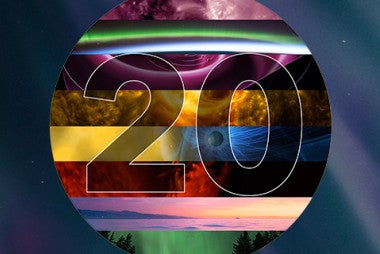
In an effort to engage users, GOMO hosted a Photo & Video Contest to celebrate 20 years of the ARC. The contest invited photographers and videographers from around the world to share photos and videos that tell visual stories about the Arctic region. Joining Armstrong, Heenehan and Hiatt helped judge the contest and Hiatt developed the contest website and image gallery.
Once all of the report content has been submitted and peer-reviewed, a team of skilled editors must prepare the document for publication. David Allen, CPAESS program specialist with GOMO and Arctic program manager, mentored Armstrong who was tapped as the ARC’s chief editor during a challenging year. Armstrong’s team – with support from many including Allen, Heenehan, and Hiatt – was persistent, creative, and worked diligently to keep the project on track. Despite the challenges of furloughs and the government shutdown, the ARC was ready for NOAA to release at the 2025 American Geophysical Union Annual Meeting.
“The new report, along with all previous ARCs, will be archived on the website which is powerful to have all of them together in one place,” says Heenehan. “This allows you to see how different topics have been covered over the last 20 years and understand a changing Arctic.”
To that end, she and Armstrong will engage with educators during a National Science Teaching Association (NSTA) Science Update webinar in January 2026 to share the latest Arctic science and ways teachers at all levels can translate and incorporate aspects of the current ARC into their curricula and take advantage of historical report data.
It takes teamwork, shared responsibility, and communication to produce the ARC each year. Read the Arctic Report Card 2025.