UCAR | CPAESS Visiting Scientist Sets Sights on Improving Seasonal Rainfall Forecasting in Africa
Africa’s climate is warming and as a result, the continent is experiencing deadly heatwaves and droughts while also experiencing heavy rains and flooding. These extreme weather events are triggering crises with devastating impacts on nearly every aspect of life – from human health, agriculture, and food security to socio-economic systems, energy production, and water availability. (Source.)
Aissatou Faye is a UCAR |Cooperative Programs for the Advancement of Earth System Science (CPAESS) Visiting Scientist at the NOAA Climate Prediction Center (CPC) – African Desk, a unit established in 1994 after recurring droughts in Africa emerged in the 1970s and persisted into the 1990s. As a result, water demand for human and agricultural uses exceeded supply. (Source.)
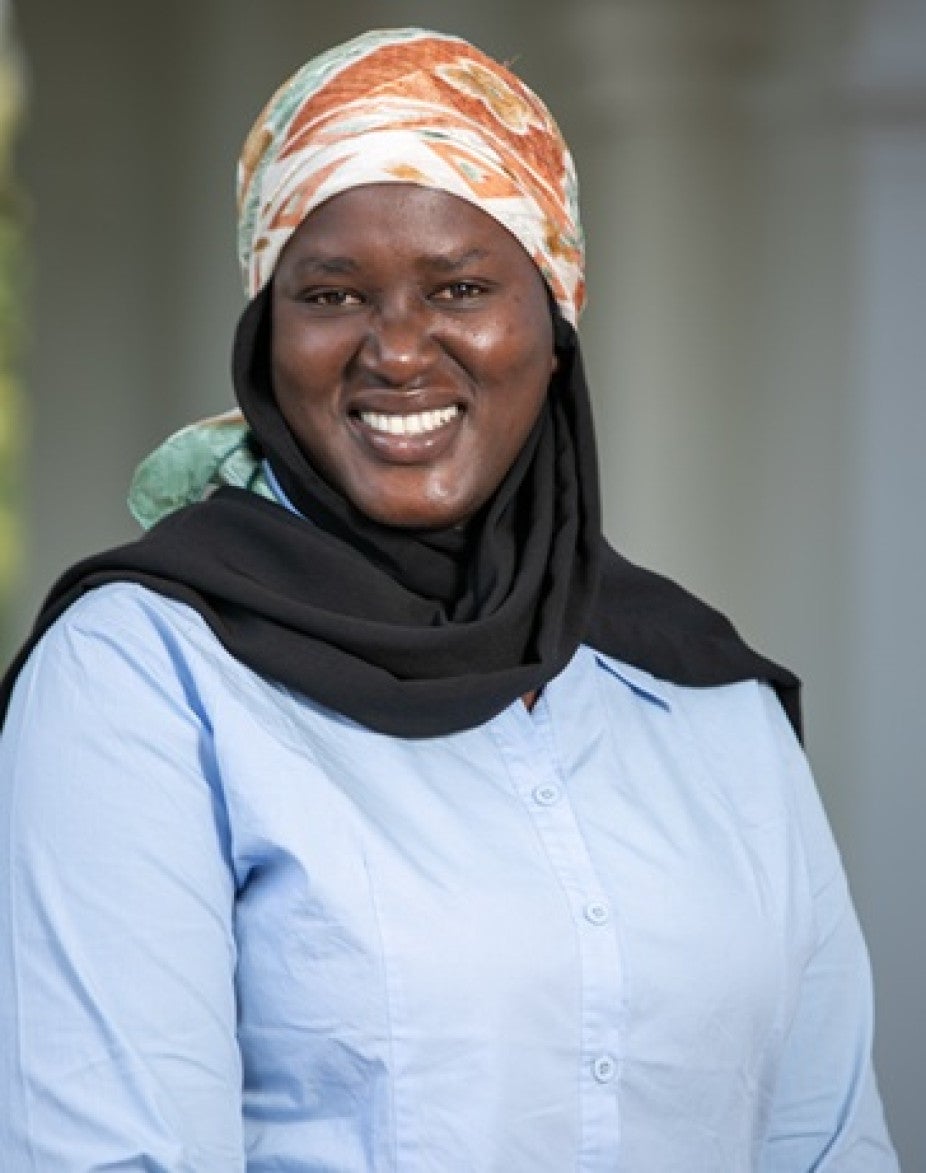
Aissatou Faye is a UCAR | Cooperative Programs for the Advancement of Earth System Science (CPAESS) Visiting Scientist at the NOAA Climate Prediction Center (CPC) – African Desk
Faye’s work centers on improving subseasonal to seasonal (S2S) forecasts using existing CPC forecast models to better predict extreme climate events and hazards such as floods and droughts across Africa. S2S forecasts look beyond short-term weather forecasts of ten days to two weeks. In addition, she is developing new S2S forecasting methods and tools that leverage machine learning to enhance prediction skill and early warning capabilities.
“Agriculture is the backbone of Africa’s economy, supporting the livelihoods of the majority of the population across many African countries. Because it is predominantly rain-fed, agriculture is highly sensitive to weather and climate patterns, including droughts and floods, which can disrupt crop production, reduce household incomes, and threaten food security,” said Faye. “In my home country of Senegal, for instance, rainfall is concentrated within just three months, from June to September, yet a large portion of the national economy depends on agriculture. With climate variability and change, we are now experiencing increasingly unusual conditions, with more frequent and prolonged extreme events such as droughts, floods, and high temperatures.”
Faye aims to produce weather hazard outlooks for Africa and to develop statistical methods and tools that improve S2S precipitation forecasts thereby improving the prediction of extreme events across the region. Predicting and understanding these climate hazards are essential for developing effective risk adaptation and mitigation strategies and strengthening early-warning systems.
One of the biggest challenges for African climate scientists is the dearth of surface observations across the continent. Unlike the U.S. and Europe that maintain a density of weather stations and archive the data, Africa lacks a similar density of stations due to financial, political, and social forces.
Typically, these ground data are used by researchers to calibrate or assess the accuracy of weather models that are generated with satellite observations. However, without reliable current and historical data, it is challenging to produce accurate weather and climate forecasts that can be used by farmers as well as researchers like Faye who are studying whether and where climate is changing. (Source)
Given the data gaps or lack of data in many regions, Faye turned to the North American Multi-Model Ensemble (NMME) system at the CPC. It is a seasonal prediction system that combines forecast information from several state-of-the-art computer climate models currently running in the U.S. and Canada producing seasonal forecasts of different climatic variables like precipitation. The beauty of the NMME is that the combination of different models produces better forecasts than running a single model alone. (Source)
A climate scientist by training, Faye started her three-year appointment with NOAA in Spring 2025 and began learning about the CPC’s models and tools. With access to a wide range of datasets – including satellite observations, in-situ measurements, and reanalysis products – Faye will soon begin integrating data from the U.S., Europe, and other sources to develop machine-learning tools for short- and long-term precipitation forecasts for Africa. Her challenge lies in constructing an accurate model that relies heavily on satellite observations due to the sparsity of ground observations.
“We want to know, for example, in the upcoming weeks or months, what and where to expect extreme climate events such as droughts, floods, heatwaves across Africa and then, with this information we can communicate different approaches to more or less rain to countries and local populations,” said Faye.
She notes that a changing climate impacts not only agriculture but human well-being, health, disease patterns, regional conflicts, and migration because it intensifies resource scarcity, economic hardship, and existing civil and political tensions. “I think climate shapes every aspect of life for me,” she said.
Faye comes from a large family and is the first, and only member to attend university and earn a Ph.D. “It wasn’t always easy, but maybe I hope my journey can inspire people back home, especially girls and women – that all of this is possible, even if you come from a low-income family,” she said.
The UCAR | CPAESS Visiting Scientist Program supports research and collaboration on Earth system science topics to build new partnerships and strengthen existing ones.