CPAESS Science Highlights at UCP All-Staff
On Wednesday, December 3rd, UCAR’s Community Programs (UCP) held a hybrid UCP All-Staff Meeting. Two CPAESS scientists were able to give brief presentations on their research during this meeting to showcase their fine work.
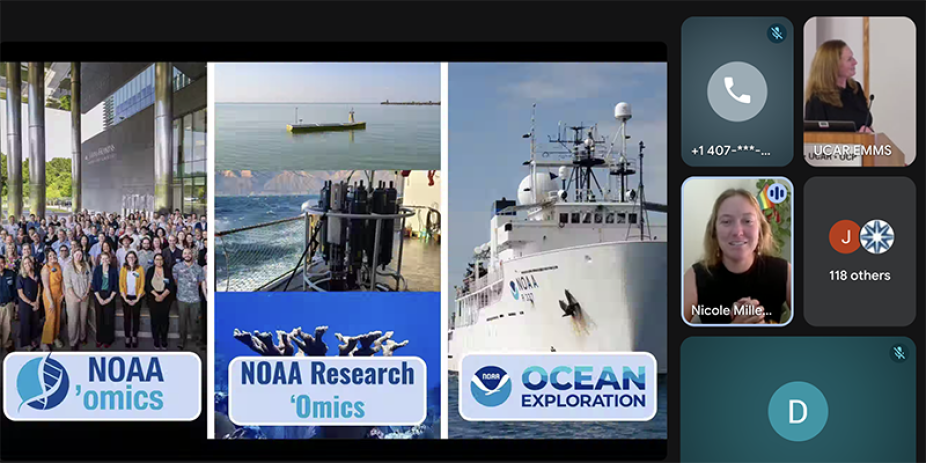
Nicole Miller presenting her work with NOAA on 'Omics at the UCP All-Staff Meeting.
Nicole Miller is a CPAESS Program Specialist at NOAA’s Office of Ocean Exploration in St. Augustine, Florida and she presented on her work with NOAA's Omics program. Of this work, Nicole shared that “‘Omics is an advanced technology that delivers faster, cheaper, and higher-quality science for the American people. By analyzing biomolecules—including DNA, RNA, proteins, and metabolites—‘omics strengthens discovery, environmental security, and fisheries management. These technologies generate unprecedented accuracy and volume of marine data at lower cost, accelerating innovation across NOAA missions. NOAA ‘Omics is a network that coordinates agency-wide efforts to maximize the value, usability, and impact of ‘omics data. The network is cross-agency, with strategic initiatives in NOAA Research and the NOAA Fisheries, and coordination led by UCAR CPAESS Program Specialist, Nicole Miller, from within NOAA Ocean Exploration. Together, these efforts help preserve U.S. leadership in biotechnology, biological resilience, and national biosecurity.” Find more resources on this work or reach out to Nicole directly.
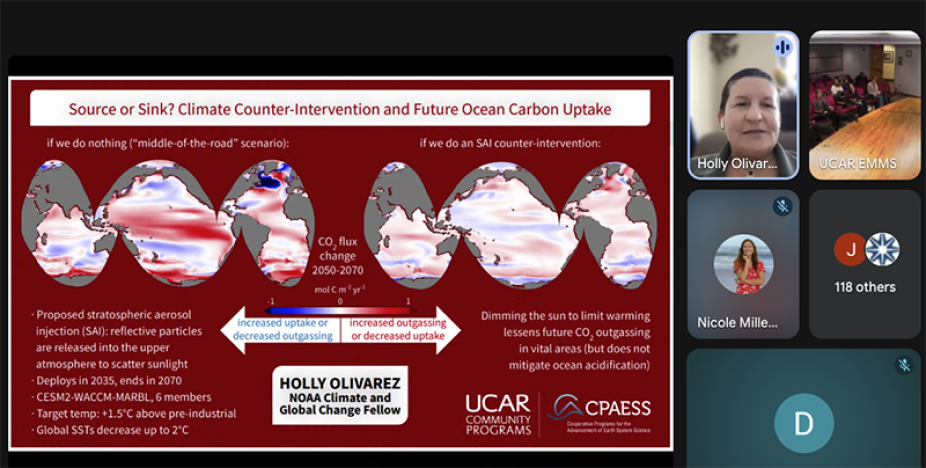
Holly Olivarez explains her research as a NOAA Climate & Global Change Postdoctoral Fellow at the UCP All-Staff Meeting.
The other presentation was by Holly Olivarez, who is currently a NOAA Climate & Global Change Postdoctoral Fellow. Holly has a long history with UCAR, having participated in the NSF SOARS program. Olivarez shared that she “is investigating the future impacts of stratospheric aerosol injection (SAI) on ocean carbon uptake using NSF NCAR’s Community Earth System Model 2. SAI is a proposed climate counter-invention strategy that, along with stopping man-made emissions, involves injecting aerosols above Earth’s weather systems to create a reflective layer that scatters sunlight back into space. Because adopting or rejecting this strategy carries both potential benefits and risks, research on its effects on the marine carbon cycle - along with the ecosystems, fisheries, and ultimately human food supplies that depend on it - is essential.” If you have any questions about this research or wish to work with Holly, she welcomes you to email her.
CPAESS is delighted that these two brilliant minds in diverse science fields were able to share their work with the broader UCAR community.