Another EPIC Workshop: UIFCW25
This summer, NOAA’s Earth Prediction Innovation Center (EPIC) and the Unified Forecast System (UFS) in partnership with University Corporation for Atmospheric Research (UCAR) delivered a five-day Unifying Innovations in Forecasting Capabilities Workshop (UIFCW25) in Boulder, Colorado on 8-12 September 2025. CPAESS staff were delighted to manage this event and have numerous staff members participate in its activities.
Throughout the week, workshop attendees focused on integrating sectors of the Weather Enterprise and fostering a community of modelers. UIFCW25 is about engaging and uniting our efforts to advance forecasting capabilities for a more informed future. The theme for this year’s workshop was “Building a Stronger UFS Community Through Collaboration and Knowledge Sharing.”
This workshop had 220 in-person attendees and an impressive 405 virtual participants. The UIFCW25 featured numerous research posters, including 58 in-person and 24 virtual presentations, which shared their work at the poster slam. Additionally, we were able to assist NOAA in their sponsorship of ten students this year.
The event included a robust agenda that included talks with illustrious speakers, a poster slam to share research, and training sessions including “Compile and Run the UFS Global- Workflow using a Container Image (Singularity) on a variety of Platforms”, “Artificial Intelligence in Weather Modeling Training,” “Introduction to Running Idealized Test Cases via the UFS Hierarchical System Development Framework,” and “NOAA AI Learning Journeys Tutorial.” Please find slide decks for many of these presentations.
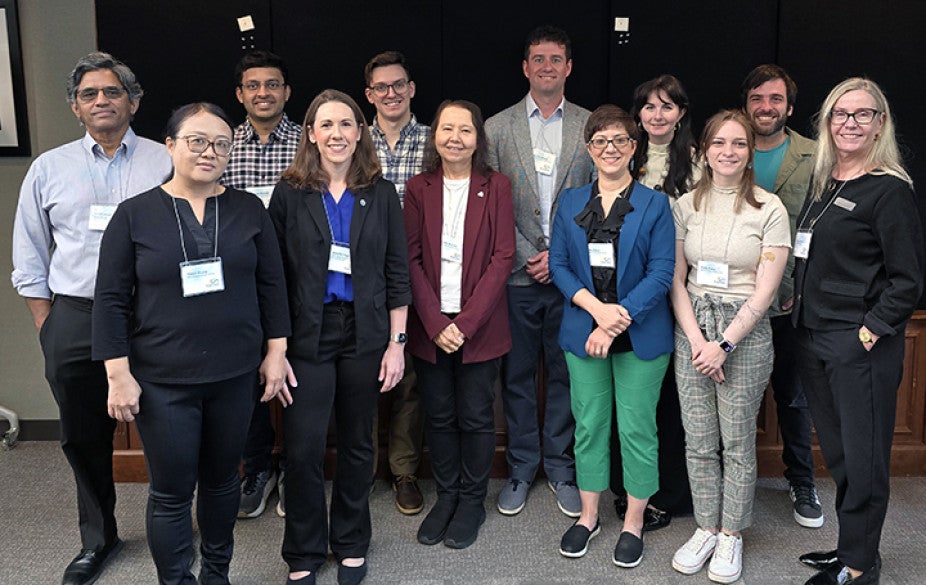
WINGS Fellows and the NOAA & CPAESS Leadership Team at this week’s Unifying Innovations in Forecasting Capabilities Workshop 2025 in Boulder. Front row: Maoyi Huang (NOAA), Jennifer Vogt (NOAA), Cindy Bruyère (UCAR | CPAESS), Gina Eosco (NOAA), Emily Faber (WINGS cohort 1), Hanne Mauriello (UCAR | CPAESS). Back Row: Chandra Kondragunta (NOAA), Shreyas Dhavale (WINGS cohort 1), Joey Knisely (WINGS cohort 1), John Ten Hoeve (NOAA), Elena Fernandez (WINGS cohort 2), and Luke Howard (WINGS cohort 2).
This workshop was a great opportunity for students in the Weather Program Office (WPO) Innovation for Next Generation Scientists (WINGS) PhD Dissertation Fellows to get together with NOAA scientists and share their research. The WINGS Fellowship develops and fosters the next generation of science, technology, engineering, and mathematics (STEM) scholars, with the goal of bolstering the future workforce of America’s Weather Enterprise. It is designed for PhD candidates who have completed their required coursework and are in the beginning stages of writing a dissertation. Fellows will work with their academic advisor and a mentor recommended by WPO and CPAESS, to provide guidance during the dissertation process. The focus of this Fellowship is on research relevant to the NOAA WPO's Earth Prediction Innovation Center (EPIC) and Joint Transfer Technology Initiative (JTTI) programs.
Our first WINGS class and their research includes: Emily Faber, “Evaluation of 10-m Wind Speed From ISD Meteorological Stations and the MERRA-2 Reanalysis: Impacts on Dust Emission in the Arabian Peninsula;” Joseph Knisely, “Exploring New Satellite Bias Correction Methodologies for Numerical Weather Prediction within Theoretical and Operational Frameworks;” and Shreyas Dhavale, “The origin and evolution of the Monsoon onset vortex and its subseasonal impacts: Integrating Theory and predictability studies using the UFS.” Our second WINGS class and their research includes: Elena Fernandez, “Implementing Machine Learning to Resolve Troposphere-Stratosphere Coupling and Teleconnections in S2S Forecasts;” Luke Howard, “Improved Utilization of Dense Observations in Data Assimilation Systems Using Machine Learning;” and Katilin Pereira, “Improvement of Lake Representation in Operational Weather Forecasting.”
WINGS fellow Shreyas Dhavale presented on “Case studies of the Monsoon Onset Vortex and early season Monsoon features using the UFS coupled model” at the UIFCW25. Additionally, Alison Gregory, UCAR | CPAESS Program Specialist & Community Engagement, shared the results for the United Forecast System (UFS) Community Survey. She discussed how these results could be used to build a stronger UFS community and enable a better understanding of science-based team dynamics. Last but not least, SPS | CPAESS Deputy Director Cindy Bruyère gave a presentation on the CPAESS-managed Weather Program Office (WPO) Innovation for Next Generation Scientists (WINGS) Dissertation Fellowship and the unique growth opportunity it provides for Ph.D. students.
NOAA, EPIC, and the UFS community leveraged UIFCW25 to bring together academia, government, and industry partners in a shared mission: advancing forecasting capabilities for the nation. The workshop not only deepened scientific collaboration but also highlighted the next generation of researchers who will carry this vital work forward.