New Stars Shine at the NASA Heliophysics Summer School

2025 Heliophysics Summer School students with deans, guest speakers, and CPAESS Staff.
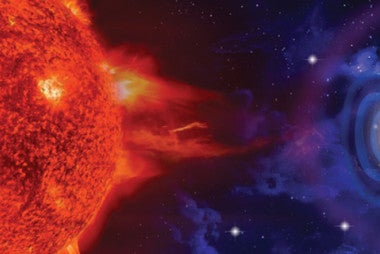
New stars were shining during the 19th year of the NASA Heliophysics Summer School held in Boulder, Colorado from August 12 - 20, 2025. Since 2007 this summer school was created to generate research scientists in the cross-disciplinary field of heliophysics. Designed for advanced graduate students, first- or second-year postdoctoral fellows, or early career researchers within two years of obtaining their PhD. The NASA Heliophysics Summer School is an interdisciplinary exploration of the physical processes connecting the Sun, solar system planets and interplanetary space. Over eight days, students examine topics ranging from the solar dynamo to the heliosphere’s interaction with the interstellar medium, to space weather impacts and observational technologies.
This year’s theme was “Data-Driven Heliophysics Exploration and Discovery.” In attendance were 28 students, drawn from a highly competitive ~20% acceptance rate of applicants. Of the 28 students in attendance, 20 were domestic and eight international. To date, this program has educated 613 students and created some incredible resources, including textbooks, that are available to all.
At the helm of this annual endeavor was NASA Senior Advisor and heliophysicist, Madhulika (Lika) Guhathakurta. With an encore appearance were our two deans Dr. Marco Velli from the University of California in Los Angeles (UCLA) and Dr. Farzad Kamalabadi from the University of Illinois at Urbana-Champaign. The Heliophysics Summer School’s well-loved instructor, Dr. Nicholas Gross of Boston University rounded out the team along with SPS | CPAESS Deputy Director Cindy Bruyère. Together, they created an agenda of action-packed lesson plans, labs, and more for students. Over the nine days, students learned a variety of subject matter from 18 lectures, discussions with questions and answers, four laboratory experiments utilizing real NASA data, a tour of NCAR’s High Altitude Observatory, and capstone group projects.
The focus of the 2025 Summer School was on the connection between our understanding of fundamental physical processes throughout all domains of the heliosphere and the observational methods and subsequent data analysis to uncover those principles. This included processes across the heliosphere - such as solar wind evolution and interactions with planetary bodies, solar EUV emissions, or atmospheric outflows from planets - and how they are described by the evolutions of physical parameters - e.g. temperature, magnetic field, energetic particle, or UV spectra. These parameters can be measured through ground or space-based remote sensing, and in-situ observations, using instruments that detect even more fundamental parameters such as particle counts or deposited energy.

Dr. Elizabeth Bernhardt gives students a tour of NCAR’s High Altitude Observatory (HAO) labs.
Through expert lectures and interactive experiences, participants explored the fundamental observation strategies and emerging data analysis used to infer the physical parameters and how they are used to address scientific questions throughout the domains of heliophysics. Emerging approaches and algorithms that extract information from data produced by physical sensors, discover patterns and causations, make predictions and advance foundational understanding using a variety of tools including artificial intelligence and machine learning will be explored.
This year was packed with brilliant speakers such as Lauren Blum (CU LASP), Bob Ergun (CU LASP), Dave Malaspina (University of Colorado), Robert Marshall (University of Colorado), Kolter Bradshaw (Princeton University), Tim Bastian (National Radio Astronomy Observatory), Craig DeForest (Southwest Research Institute), Alex Young (NASA's Goddard Space Flight Center), Andres Munoz Jaramillo (Southwest Research Institute), and many more including Holly Gilber of (NCAR HAO). The 2025 Agenda and schedule provide a wealth of information free to anyone, as well as presentations and video links to lectures.
One of the defining strengths of this school is the lasting sense of community it has cultivated over the years. From this foundation have emerged valuable resources such as textbooks, a video library, the NASA Jack Eddy Postdoctoral Fellowship program, and the NASA Eddy Symposium. Many students and early-career scientists begin their journey through one of these avenues and later engage in others, creating a network of experiences that build upon each other. This interconnected framework strengthens each program while providing vital support and educational opportunities for the growing heliophysics community. Of our many guest speakers, three were Jack Eddy fellows, and David Malaspina was part of the very first NASA Heliophysics Summer School. It is wonderful to see the support and edification these alumni of other programs bring to the heliophysics community often turning full circle.
The NASA Heliophysics Summer School accepts applications each winter for the following summer. Please spread the word and join this innovative and growing community.