Triumph of teamwork: Learning more about sperm whale hearing
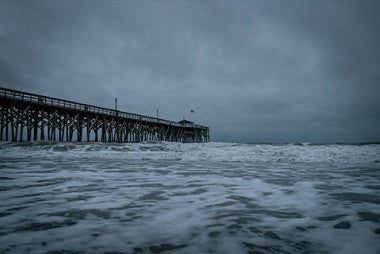
In May 2025, a male sperm whale washed up on the South Carolina shore and immediately set in motion a team of mammal experts who determined that humane euthanasia was necessary given its extremely poor condition.

Credit: NOAA Northeast Fisheries Science Center.
The sperm whale’s death, like other deaths in nature, will provide an opportunity for researchers to understand more about its systems, including its hearing. A team of researchers led by Ted Cranford of San Diego State University, was on site to preserve the pristine condition of the sperm whale head and freeze it in preparation for future CT (computed tomography) scanning.
UCAR | Cooperative Programs for the Advancement of Earth System Science, in coordination with NOAA, provided emergency support for scientific staff traveling to the rescue site.
“The first time we CT scanned a sperm whale head – 26 years ago – we did not have enough resolution in the scans to study hearing. Instead, we focused on the anatomy of sound generation in the world’s largest nose,” wrote Cranford in a message to his team.
The earlier study provided the first look at the undisturbed anatomic geometry within the sperm whale nose. “The complex, uniquely asymmetric nasal anatomy is known to produce the most intense underwater sounds ever recorded from a marine mammal. Sperm whale sounds approach the upper limit of biologically generated underwater acoustic intensity, which immediately raises the question, how do they avoid damaging their own auditory system?” (Source, T. Cranford memo)
“Eventually, we plan to describe the sperm whale's hearing apparatus and its performance characteristics using finite element modeling tools we have developed over recent decades,” notes Cranford.
With gratitude and great esteem for all of his colleagues, Cranford recognized Annie Gorgone, Scott Pollock, Brian Bittinger, Nick Kaney, and Tonya Johnson for their crucial support at the NOAA Beaufort Laboratory and Matthew Johnson who “worked tirelessly to refine and sort out the intricate logistics, ironing out every potential and apparent snag.”